23/10/2026
The Good Lobby France has just published the largest survey yet on how associations in France advocate and where they get stuck.
On 14 October, The Good Lobby France published Les défis du plaidoyer associatif : de l’expertise à l’influence (“The challenges of association advocacy: from expertise to influence”), a survey of associations, funders and advocacy support providers. Its central finding is a paradox.
More advocacy, less influence
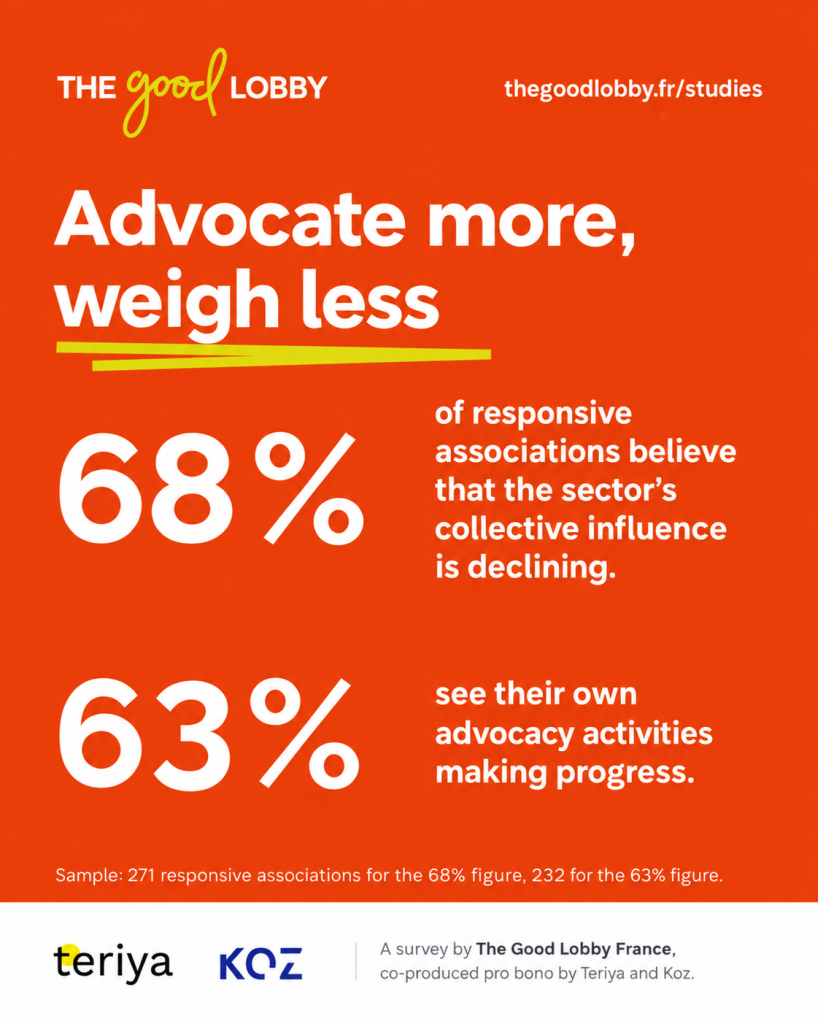
Among the 281 associations, federations and networks that responded, 63% say their own advocacy activity has grown over the past three years. Yet 68% believe the sector’s collective influence has declined over the past three to five years. The two views sit side by side even within the same organisations, so the perceived decline seems to come from the environment rather than from a lack of effort.
A hostile climate
Respondents describe a political climate that has become tougher:
- 72% see the rise of political currents that question the role of intermediary bodies and organised civil society.
- 44% point to hostile discourse about NGOs.
- 57% expect an unfavourable environment for advocacy over the next 12 to 18 months.
Some organisations describe local officials who stop engaging with them after public criticism. Others describe pressure to stay “neutral”, or a quiet self-censorship. As the report puts it, being non-partisan does not mean being apolitical.
The real bottleneck is resources
Most associations say the problem is not skills but means. 80% have no dedicated advocacy budget. Where someone does spend time on advocacy, two-thirds of the time there is no full-time person. Smaller organisations feel this most: 77% of those with fewer than 50 staff cite a lack of human resources, against 45% of larger ones.
Funders broadly agree. 21 of 22 name the lack of dedicated budget as a top obstacle, but only 11 of 23 currently support advocacy. Most of those give under €50,000 a year, and only 3 of 19 plan to increase their support.
Responses: collective action and resilience
Despite the pressure, engagement holds. 61% of associations have strengthened or adapted their advocacy, and only 3% have scaled it back. The most common response is to work together: 62% plan to take part in more coalitions. The survey also finds that collective action requires resources, since the least-resourced organisations are the least likely to join coalitions.
The French findings are a reminder that expertise and legitimacy do not translate into influence on their own, and that small, grassroots organisations are the ones that struggle most to make that jump. The same questions apply to civil society in Brussels and across Europe.