

27/10/2025
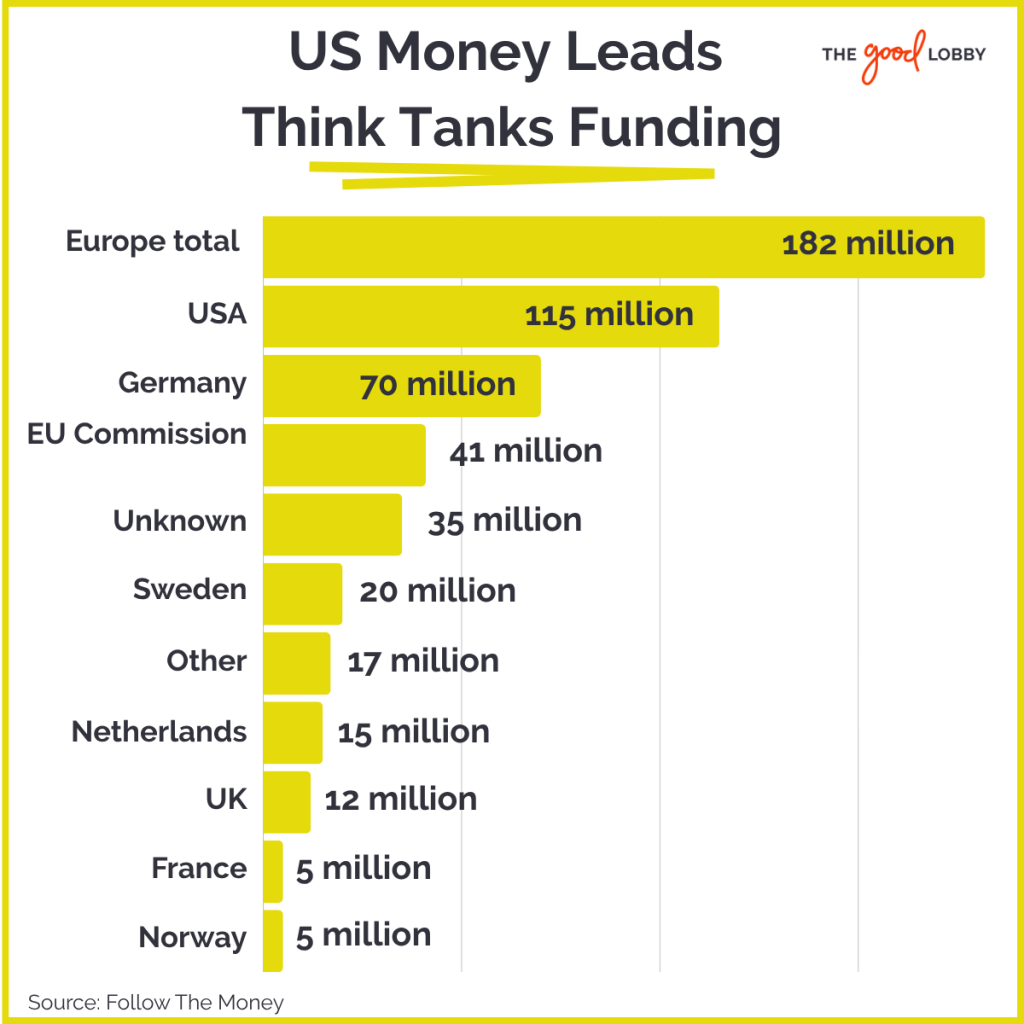
A recent investigation by Follow the Money unveiled that over ⅓ of Brussels’ think tanks are funded by either US philanthropies or US multinationals, mainly from large technology companies. This raises important questions about transparency and foreign influence in EU policy-making. Of the total funding of approximately €350 million, at least €115 million came from American sources, making the United States the largest national contributor to European policy research.
The hidden power of “independent” expertise
Think tanks are often described as independent, objective or non-partisan, characteristics that give them credibility and privileged access to European institutions. The European Commission regularly consults them when developing policy ideas, sometimes even using their reports as a preliminary testing ground for new initiatives.
But the FTM report highlights how financial dependence on major American donors – notably companies such as Google, Microsoft, Meta and philanthropists such as Bill Gates – can undermine this independence.
In 2023 alone, the three tech giants spent more than €7 million funding leading think tanks in Brussels. Among the organisations receiving the most funding from the United States are the World Resources Institute, the Brookings Institution and the Atlantic Council, which receive around half or more of their total budget from American donors.
Think tanks as gateways for influence
Experts interviewed by FTM warn that these financial ties could serve as a ‘gateway’ for American political and commercial interests in the EU’s decision-making process. As the European Union pushes forward with ambitious digital regulations, such as the Digital Markets Act (DMA) and the Digital Services Act (DSA), US technology companies have a clear interest in influencing debates on data privacy, market competition and online security.
From the White House to Brussels
The report also highlights the broader geopolitical context. Under the current US administration, American companies, including tech giants, are under increasing pressure to align themselves with national political priorities, such as the rollback of diversity and inclusion programmes. Some European think tanks have even received letters from US authorities warning them against organising events related to gender or diversity.
According to experts such as Fabian Zuleeg of the Centre for European Policy, this highlights how financial dependencies can translate into political influence, and why transparency and due diligence are essential to preserving the EU’s autonomy.
Making policy transparent and accountable
At The Good Lobby, we believe that transparent, accountable and responsible lobbying in policy-making are cornerstones of a healthy democracy. Follow the Money’s investigation is a timely reminder that financial transparency must be at the heart of EU public affairs, especially for those who shape ideas and influence decision-makers.
When think tanks act as intermediaries between private funders and policymakers, it is essential to clearly disclose funding sources and potential conflicts of interest in order to maintain public trust.
As Europe faces complex regulatory challenges ranging from AI and data protection to ecological transition and foreign policy, it is essential to guarantee the independence and accountability of experts in order to preserve the democratic legitimacy of the EU’s decision-making process.