

26/01/2026
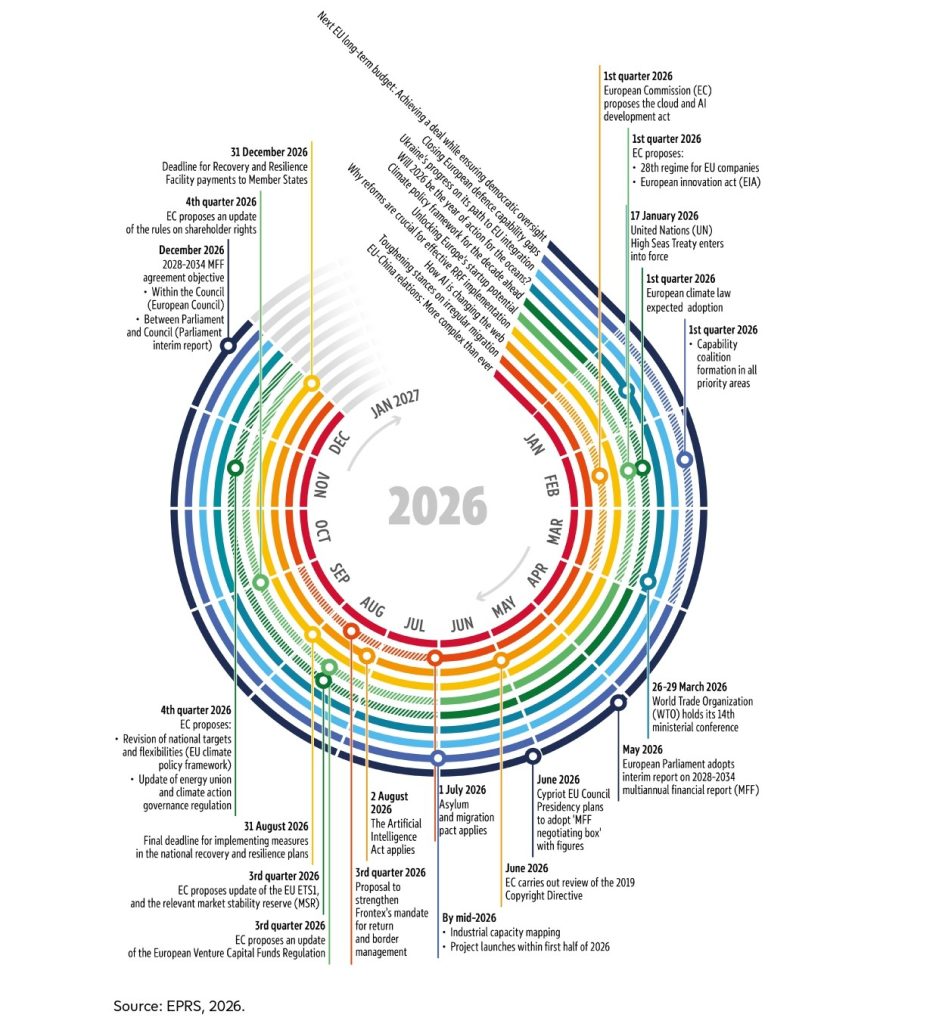
Every year, the European Parliament Research Service (EPRS) highlights the political developments most likely to influence the European Union in the coming year. The outlook for 2026 paints a picture of a Union facing geopolitical uncertainty, economic transition, rapid technological change and growing environmental pressures.
Here are 10 issues that will define the 2026 EU agenda and why they deserve our attention.
-
The Next EU Budget: Big Stakes, Big Debates
Discussions on the EU’s next multiannual financial framework (MFF) for the period 2028-2034 are expected to gather pace in 2026. At the heart of the debate are the EU’s ambitions for funding common priorities and the influence that the European Parliament should have on long-term spending decisions.
The outcome will determine how EU funds are allocated in the coming years, influence investment in areas such as research, cohesion, defence and climate action, and determine how well prepared the Union is for future challenges.
-
Ukraine’s EU Path: A Pivotal Year
Ukraine’s progress towards EU membership will remain a political priority. While reform efforts have advanced, enlargement continues to raise sensitive issues among Member States regarding timing, institutional capacity and political consensus.
How this process unfolds will speak volumes about the EU’s geopolitical ambitions, its commitment to supporting Ukraine, and its vision for long-term stability on the European continent.
-
Defence Capability Gaps: Strengthening Europe’s Security
Growing security concerns have put the spotlight on Europe’s defence capabilities. From joint procurement to industrial capabilities and military coordination, the EU is seeking ways to fill long-standing gaps.
These discussions go far beyond military equipment and touch on strategic autonomy, industrial competitiveness and Europe’s role alongside NATO in an increasingly uncertain global environment.
-
EU–China Relations: Managing Competition and Cooperation
Relations with China remain complex and often contradictory, combining economic ties, strategic rivalry and political tensions. The EU continues to refine its approach, seeking to protect its interests without closing the door to cooperation.
The choices made in this relationship will have repercussions in all areas, from supply chains and technology to climate diplomacy and the EU’s position in a rapidly changing global balance of power.
-
AI and the Future of the Web
Artificial intelligence is rapidly transforming how the internet works, from content creation to online services and information flows. In 2026, the EU will continue to shape its regulatory and policy framework for AI.
These decisions will influence the development of innovation in Europe, the protection of digital rights and society’s adaptation to the profound changes affecting work, communication and public debate.
-
Europe’s Startup Ecosystem: Turning Innovation into Scale
Europe has no shortage of innovative start-ups, but turning promising ideas into global successes remains a challenge. Policymakers are focusing on access to finance, regulatory simplification and talent retention.
The ability to help start-ups grow will play a key role in Europe’s economic dynamism, job creation and technological leadership in the years to come.
-
Irregular Migration: A Persistent Global Challenge
Irregular migration continues to put pressure on borders, asylum systems and relations with neighbouring regions. The EU is still seeking sustainable solutions that balance responsibility sharing, border management and humanitarian concerns.
The way Europe manages migration will continue to influence public debate, internal solidarity and the EU’s credibility as a global actor committed to human rights.
-
Climate Policy Beyond 2030
As the EU moves closer to its 2030 climate targets, attention is now turning to what comes next. Policymakers are considering how to balance long-term climate goals with economic competitiveness and social fairness.
The direction taken today will influence investment choices, industrial transformation and Europe’s ability to lead the way in the global fight against climate change.
-
Protecting the Oceans: A Growing Policy Priority
The oceans are becoming increasingly important in EU policy-making, due to growing concerns about pollution, biodiversity loss and the impact of climate change on marine ecosystems. New initiatives aim to strengthen the place of ocean protection in EU policy.
A healthier approach to ocean governance promotes food security, environmental resilience and the EU’s broader sustainability ambitions, both internally and globally.
-
Lessons from the Recovery and Resilience Facility
The Recovery and Resilience Facility, created in response to the COVID-19 crisis, is entering a phase of reflection and evaluation. Attention is now turning to what it reveals about joint borrowing, incentives for reform and crisis management.
The lessons learned from this experience are likely to influence how the EU responds to future shocks and designs its large-scale investment tools.
Together, these ten questions show a European Union at a crossroads, which must strike a balance between immediate pressures and long-term choices. The decisions taken in 2026 will not only address current challenges, but also set the direction for Europe in the years to come, making this a year to watch closely.