

The European Citizens’ Initiative – the first instrument of direct transnational democracy ever invented – is about to turn 15 years old, but only yesterday it was recognised as “one of the political rights” that ensure the participation of citizens in the democratic process. That’s what the EU General Court decided in End of the Cage, the first judgment sanctioning the Commission for failing to act on citizens’ demands.
Background
The first ECI ever registered was Fraternité 2020, filed on 9 May 2012 (Europe Day), just five weeks after the ECI Regulation entered into force. It called for stronger EU exchange programmes like Erasmus. The second was registered by Professor Alemanno’s students – One Single Tariff – asking for the elimination of roaming charges.
Since then, the tool has been used widely but with uneven results. Out of the 136 initiatives formally registered (with some more having failed to make it through the registration process), with only 15 ever crossing the one-million-signature threshold. Virtually none of them has given rise to a legislative action.
Recently, the Commission refused to register an ECI: the Save Europe Act, an initiative calling for a moratorium on non-Western immigration. Although the ECI has previously been used to promote conservative ideas, this marked the first time the Commission rejected an initiative on the grounds that its proposal was “manifestly contrary to” an EU founding value. The decision has since been challenged before the General Court (Case T-621/26). This episode also illustrates the broader dynamics surrounding the instrument.
As Professor Alberto Alemanno has observed, a narrow, legalistic interpretation of the ECI may encourage organisers to reinvent it through creative uses aimed at attracting public attention, or as in his recent ECI – My Flight, My Right – influencing an ongoing legislative process (and winning the argument).
Meanwhile, the Commission recently registered a new initiative, ‘Creation of a European Digital Space (.IA) for Sovereign AI Governance’. The organisers want the Commission to propose a framework for trusted digital spaces and protect the .IA domain. They now have six months to launch their signature campaign.
State of Play
Of the 15 valid ECIs, 14 have received a formal response from the Commission, while one remains pending.
The most recently verified initiative which remains pending is the Justice for Palestine ECI which calls for the full suspension of the EU-Israel Association Agreement. It gathered around 1.3 million signatures, making it the fastest ECI to reach the required signature threshold.
And we understand that a few others, including one countering the EU Simplification Agenda insofar as it rolls back on the standard of protection across health, digital, consumer protection within the EU, may soon be registered.
Do ECIs bind the Commission to act?
Reaching the threshold is not the end of the story, and what comes after has just been tested in court. The End the Cage Age ECI, led by Compassion in World Farming and supported by Eurogroup for Animals and The Good Lobby, brought an action for failure to act against the Commission. On 25 November, the General Court ruled in its favour (Case T-151/24). The Commission had promised in 2021 to propose a cage ban by the end of 2023, and it missed that deadline. The Court held that its duty to provide a timeline did not end with its initial communication. For as long as the Commission maintains its intention to act, it must provide an updated timetable and explain any changes to it. In other words, a response to an ECI does not close the file and can’t leave its organisers in a legal limbo.
Let’s take stock of the ECI’s use, at a time of unprecedented political transformations within Europe and growing citizen mobilisation.
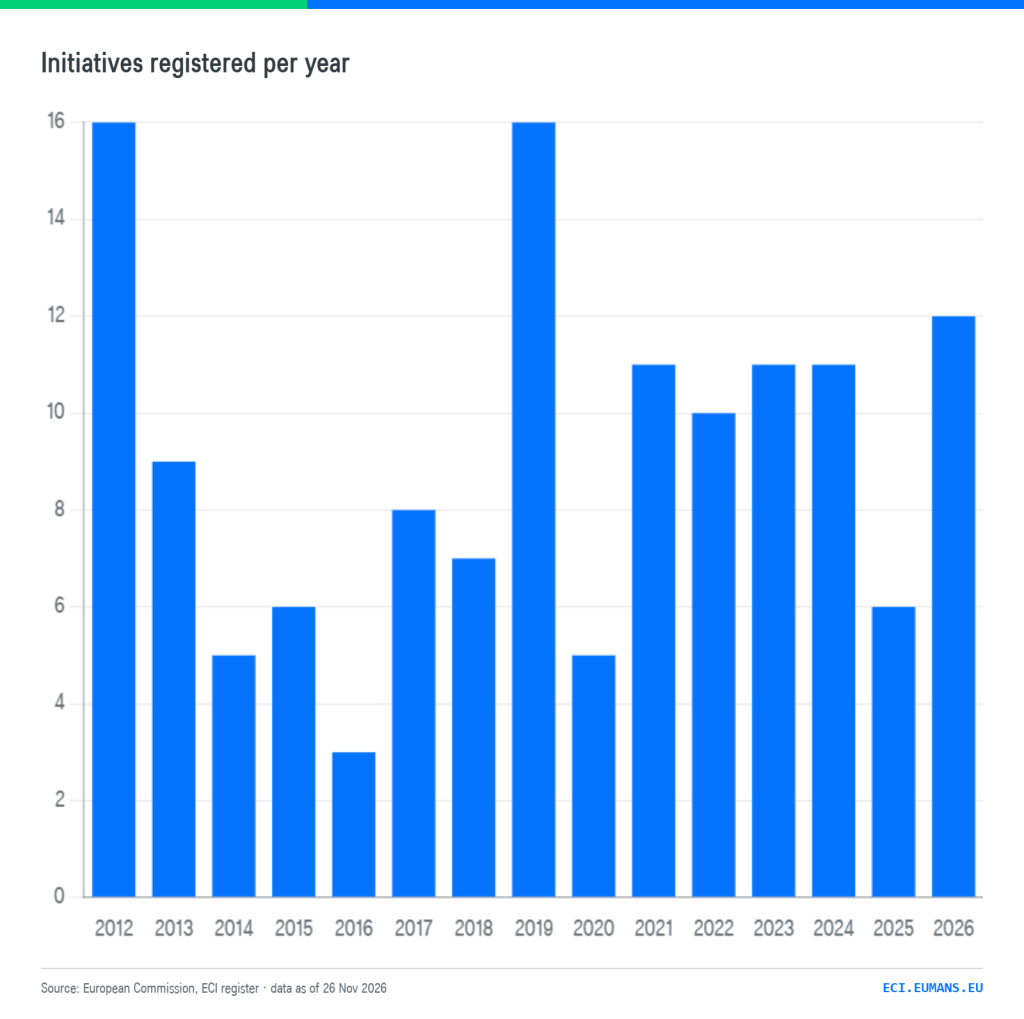
What is the ECI
At least seven EU citizens, resident in seven different Member States, can launch an “initiative inviting the European Commission, within the framework of its powers, to submit any appropriate proposal for a legal act of the Union, on matters where citizens consider such an act is required for the purpose of implementing the Treaties” (2019 ECI Regulation).
If they gather 1 million signatures, with the required minimum reached in at least seven Member States, the initiative is valid under Article 3 of Regulation (EU) 2019/788. The European Parliament organises a public hearing (Article 14), the Commission receives the group of organisers and gives them the opportunity to explain the initiative in detail (Article 15), and within six months of publication the Commission must set out, in a communication, its legal and political conclusions on the initiative and the action it intends to take, if any, giving its reasons either way (Article 15).
What the Regulation does not do is to force the Commission to deliver on the demand posed. Reaching the threshold guarantees a meeting, a hearing, and a reply, not a legislative follow up.
The 15 successful initiatives, in order of signatures’ validation, are: Right2Water (2013), One of Us (2014), Stop Vivisection (2015), Ban Glyphosate (2017), Minority SafePack (2020), End the Cage Age (2021), Save Bees and Farmers (2023), Stop Finning (2023), Save Cruelty Free Cosmetics (2023), Fur Free Europe (2023), Cohesion Policy for the Equality of the Regions (2025), My Voice, My Choice (2025), Ban on Conversion Practices (2026), Stop Destroying Videogames (2026), and Demand the full suspension of the EU-Israel Association Agreement in view of Israel’s violations of human rights (2026).
15 validated initiatives, but one mixed record
Of these, six now sit in a genuine limbo, not rejected outright, but stuck between a Commission commitment to act and a Commission not following up. That gap has pushed organisers into new territory for the ECI mechanism, after a petition to the EP then a complaint to the Ombudsman it ended up before the Court of Justice of the EU.
End the Cage Age asked the EU to phase out and ultimately ban cages in animal farming. The Commission agreed in 2021 and promised a legislative proposal by the end of 2023. It missed that deadline, and quietly dropped the promise from its work programme. 57 animal-protection NGOs filed a complaint with the European Ombudsman in November 2023, represented by Prof Alberto Alemanno, the founder of The Good Lobby.
When that went nowhere, the Citizens’ Committee sued the Commission before the Court of Justice (Case T-151/24), for failure to act, by notably not providing a timeline. The Court held a public hearing on 5 March 2026 and delivered its judgment on 25 November, upholding the action. It found that the Commission had to provide an updated timeline after missing its 2023 deadline.
This statement of principle is now requiring the Commission to promptly respond to the other five successful ECIs left waiting in line.

Fur Free Europe asked for an EU-wide ban on fur farming and fur sales. The Commission’s December 2023 reply deferred the decision, requesting an EFSA opinion and promising a final position by March 2026. EFSA’s July 2025 opinion was unambiguous: cage-based fur farming cannot meet the animals’ welfare needs. Yet ahead of its own deadline, the Commission held closed-door workshops with fur industry representatives while ignoring the ECI Committee’s meeting requests. The case was escalated to the European Ombudsman in February 2026, who opened an inquiry and ordered the Commission to respond to organisers first. The March deadline has since passed without a reply. The Good Lobby has been assisting the organisers.
Stop Finning asked for an EU-wide end to the shark fin trade. The Commission’s July 2023 reply led to new customs codes, useful, but far short of the trade ban organisers wanted. By March 2026, with an impact assessment commitment months overdue and no revised timeline offered, organisers, supported by The Good Lobby, filed an Ombudsman complaint alleging maladministration. The complaint explicitly frames Stop Finning as part of a broader pattern rather than an isolated failure, citing End the Cage Age and Fur Free Europe as evidence that the Commission’s follow-through on successful ECIs has become systemic rather than incidental. As of writing, the Ombudsman’s inquiry is ongoing.

Ban on Conversion Practices demanded for a binding EU-wide ban on conversion practices targeting LGBTIQ+ people, and having such practices classified as a “Euro-crime” under Article 83 TFEU. The Commission’s May 2026 reply acknowledged the harm these practices cause but stopped at a non-binding Recommendation to Member States, due by 2027, developed through a structured dialogue with its Expert Group on LGBTIQ+ equality. No ban, no Euro-crime listing, and that despite European Parliament resolutions in April 2026 explicitly calling for those demands to become law. The EU now faces a tension between growing efforts to crack down on conversion practices and the difficulty of translating that recognition into an effective Europe-wide ban. On 16 September, President von der Leyen announced that the Commission would adopt a recommendation in 2027 calling on EU countries to ban conversion practices. On 25 September, the organisers of the successful European Citizens’ Initiative ‘Ban on conversion practices in the EU’ met with Commission staff to discuss the initiative’s follow-up.
My Voice, My Choice was possibly the most notable ECI ever registered, asking the Commission to establish an EU financial mechanism that Member States could opt into to fund cross-border access to safe abortion care for people in the EU. Launched in the wake of Roe v. Wade’s reversal in the US, it became one of Europe’s largest contemporary feminist movements, gathering over 1.1 million signatures and the backing of more than 300 partner organisations. It also secured something no ECI had before: Slovenian Prime Minister Robert Golob became the first serving EU head of government to publicly back an ECI. In the weeks before the Commission’s reply, equality ministers from nine EU governments, wrote to Hadja Lahbib, The EU Commissioner for Equality, urging her to act, while former EU heads of state and government Mary Robinson, Sanna Marin, Dalia Grybauskaitė and Tarja Halonen (along with other non-EU heads of states) added their names to an open letter and urged President Ursula van der Leyen and members of the European Commission doing the same.
The European Parliament backed the initiative twice, in a Gender Equality Strategy report in November 2025 and in a dedicated resolution that December. When the Commission replied in February 2026 to the organisers, it stopped short of setting up the dedicated EU solidarity fund organisers sought, but confirmed, for the first time explicitly, that Member States may voluntarily use existing European Social Fund Plus (ESF+) resources for abortion care. But nine months on, the Commission has shown little appetite to actually operationalise the mechanism it promised, leaving Member States who want to opt in with no clear process for doing so. Historic first, or a consolation prize? Depends who you ask, especially now that the commission is slow walking the opt in clause by member states such as Spain and the Netherlands.

Stop Destroying Videogames asked for a binding legal requirement that publishers keep purchased games playable rather than remotely disabling them. In its June 2026 reply, the Commission concluded it could not, at this stage, impose such an obligation, citing publishers’ intellectual-property rights. Instead of legislation, it offered a voluntary industry code of conduct to be negotiated by the end of 2026, a consumer-awareness push, and a reporting exercise on the existing Digital Content Directive. Organisers say they will now push for a binding fix through the pending EU Digital Fairness Act instead.
Failing upward
Interestingly, some of the ECI’s biggest policy wins never even hit 1 million signatures. The One Single Tariff and the Single Communication Tariff Act never came close, yet they’re widely credited with building the momentum behind “Roam Like at Home,” the rule that abolished EU roaming charges for good. Tax the Rich barely cleared 200,000 signatures and still got a nod in the Commission’s own 2024 Annual Taxation Report. It’s a strange kind of success: the ECI mechanism sometimes works best not as a legislative trigger, but as a pressure valve that legitimises an idea long before it ever becomes law. As put by Professor Alberto Alemanno in Verfassungsblog, the ECI reveals “deeper tensions about the instrument’s purpose and effectiveness,” tensions that cut both ways: some initiatives fail the threshold and still move policy, while others clear the threshold and get nothing but a hearing room.
So does it work?
That’s really the question hanging over the whole mechanism right now. As trust in EU institutions weakens and the political centre keeps leaning on the far right, the ECI is one of the few tools that lets citizens claim a direct line to Brussels. But a direct line to a hearing room isn’t the same as a direct line to legislation, and the record of the last ECIs – missed deadlines, court cases, downgraded “recommendations” instead of directives – makes that gap hard to ignore.
This is why the End the Cage Age judgment matters. By ruling that the Commission must keep an updated timeline for as long as it intends to act, the Court has shown that organisers can hold the Commission to account after the one-million mark. It does not force the Commission to legislate, but it makes a promise made in response to an ECI harder to let lapse. That is a meaningful safeguard for the initiatives now collecting signatures.
The mechanism remains active, with 13 initiatives currently collecting signatures.
The Good Lobby continues to monitor and assist many ECIs by promoting this instrument of transnational democracy.