Every year, The Good Lobby Summer Academy gathers a select group of leading thinkers, practitioners, and academics working internationally on new forms and politics of influence, mobilisation and lobbying.
This unique event is the perfect training or refresher for advocacy professionals, both from civil society and the private sector. You will leave with a deeper understanding of new forms of participatory politics in a geopolitically-shuttered world.
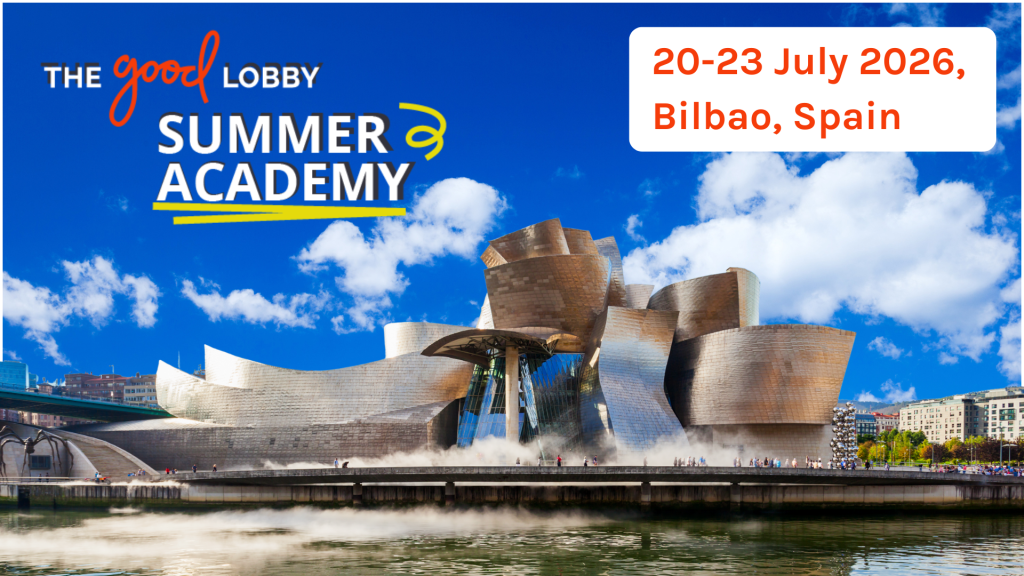
This edition of The Good Lobby Summer Academy took place on 20-23 July 2026 in Bilbao, Spain.
The next edition of The Good Lobby Summer Academy will take place on 19-22 July 2027
Agenda
Who will be our truth tellers?
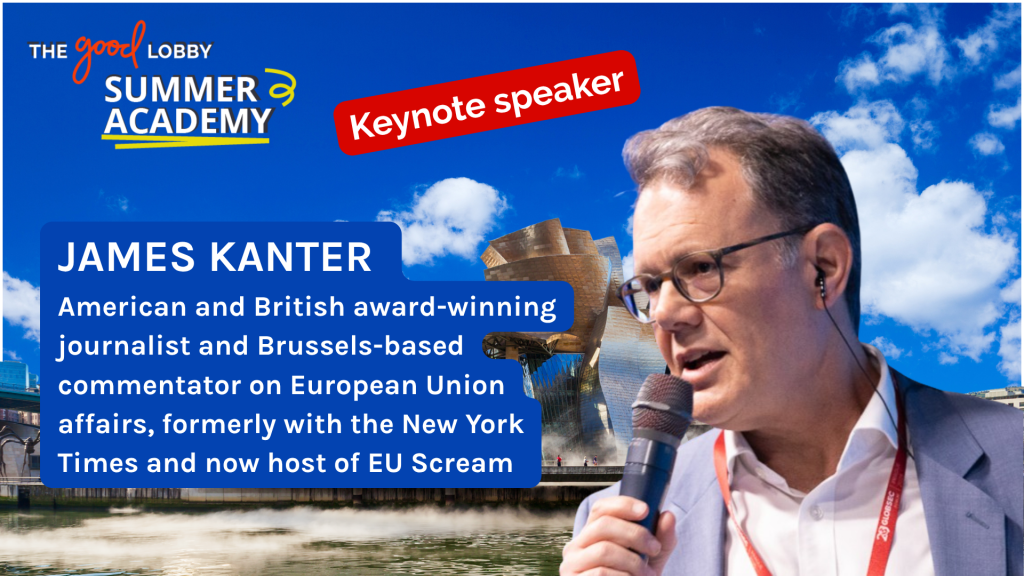
Europe and other regions’s biggest stories are being told. But are they being told right? Former New York Times correspondent and EU Scream podcast host James Kanter cuts through some dominant narratives on European current affairs and asks what’s being left out. He’ll also prompt the audience to consider who — from influencers and civil society to think tanks and academia and institutions — might be best placed to do a better job in an era of epochal changes in politics, technology, security and the climate.
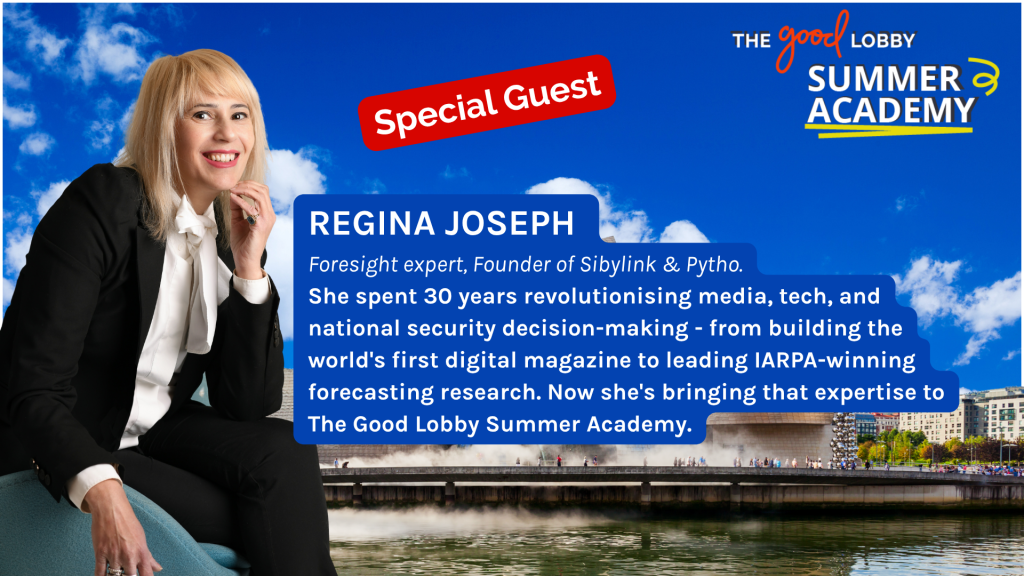
Cassandra Says Midnight Is Now: Preserving Europe’s Fragile Future. What does Europe’s AI future look like?
It’s 2031, and the warnings nobody heeded have come due. Led by superforecaster Regina Joseph, this interactive simulation puts participants in the shoes of policymakers, technologists, and civil society actors racing to map the EU’s AI existential risk landscape before it’s too late. Drawing on the Europe 2031 scenario, teams will forecast — with real confidence intervals — where current trajectories lead by the end of 2026, and design the mitigation strategies that might still bend the curve. The clock is already running.
-
AI agentic rulemaking: What does it look when AI begins making the rules? (Joe Foti, Open Government Partnership and Regina Joseph, Founder, Sibylink)
In this session, we will discuss the difference between agents and other types of AI. We will look at how this might change regulation and rulemaking for the better. Case studies from anti-bribery and pollution control will provide interesting thought experiments. As a group, we will explore questions such as what will it mean to have dynamic compliance and enforcement? (And what are the technological antecedents to do this well?), and how will this shape how rules are written? How will this shape lobbying and advocacy around those rules? How will this change the nature of policy capture? Assuming dynamism and agentic “discretion” in enforcement and compliance, what tools of transparency do we need? What capabilities for oversight are underdeveloped, and where are there new opportunities for performance measurement?
-
Uncovering Misleading Consensus and Lack of Transparency in Corporate Lobbying (Jana Hoess and Peter Webster, EIRIS Foundation)
The success of corporate lobbying depends on many different factors. One of those factors can be the ability to present a united front of ‘the industry’s position’ which carries a lot of weight with policy makers. However, research conducted by the Social Lobby Map demonstrates these claims can be misleading. Drawing on our research into lobbying around the EU CSDDD, this session will present practical examples of how misleading representations of industry unity are constructed and communicated. By looking into these practices, the session aims to contribute to broader discussion on transparency and accountability, and democratic legitimacy in corporate lobbying on social policy.
-
Spamming the Regulator: Corporate Strategies and Captured Research to Minimise Competition Oversight and Lessons on Epistemic Inequality (Helena Malikova, European Commission, Ioannis Lianos, University College London)
Regulation is facing myriad pressures from political polarisation to attacks on science and overreliance on interest-driven lobbies. Among the latter is the strategy of spamming the regulator. The strategy consists of an oversupply of expert economic reports that contain complex modelling and unverifiable assumptions, with the objective of overwhelming competition investigators while disguising the accumulation of market power. “Spamming” not only makes it harder to determine what is factually true but also diminishes the scope for shared, evidence-based understanding in public policy.
-
Why Deregulation Is Winning: Demystifying Europe’s Anti-Regulation Lobbying (Alberto Alemanno, The Good Lobby, Julia Manresa, AVAAZ, Liesbeth Van Den Bossche, WWF, Carlota de Paula Coelho, B Lab Europe)
Europe is experiencing a deregulation moment framed as simplification in the name of competitiveness. Bringing together civil society voices and progressive corporate actors from across the advocacy spectrum, the session maps the rhetorical strategies driving the simplification agenda, identifies the fictions embedded in the competitiveness framing, and explores how progressive actors can reclaim the narrative.
-
Beyond Political Philanthropy: How Private Wealth Can Defend Civic Power (Neil Campbell, The Good Lobby, Elsa Özmen, Independent, Martino Cortese, Fondazione Nidi Fioriti)
Civil Society has had a bad year. Advocacy impact has been diluted by executive decision-making/maladministration in public institutions, political regression, funding gaps and anti-NGO rhetoric. Delays, restrictions and withdrawals of bilateral or European Commission funding continue to place more and more NGOs in survival mode. Narratives to undermine the role and space for civil society are abundant. This session asks what political philanthropy means when nearly everything is political, and how foundations can better support advocacy, resilience, and progressive change. It explores what philanthropy is doing, what it could do differently, and how private wealth can help defend civic power without replacing it.
-
More than compliance: Collective action for the future of responsible business (Carlota de Paula Coelho, B Lab Europe and Sarah Cerange, B Lab France)
How to keep impact-driven businesses engaged in advancing and scaling responsible business conduct while making sense of fast‐moving legislative agendas? Here we would like to present some of our coalitions, where B Corps convene to think outside the box – that is, beyond compliance with EU legislation – to innovate and improve corporate performance.
- Lobbying for the Youth and Future Generations (Alberto Alemanno, The Good Lobby, Jonathan Hoffmann, Bertelsmann Stiftung, Willem van Dam, Oxfam, Joe Foti, Open Government Partnership)
Future generations remain structurally underrepresented in political systems shaped by short-term incentives. This session explores key institutional design challenges, strategies for building political support for long-term governance, and the role of narratives in making future-oriented politics resonate beyond expert circles. Combining insights from political theory and practical advocacy experience in Germany, the session engages participants in exploring the tensions and trade-offs of representing future interests in democratic policymaking. -
Who Speaks for Business? Trade Associations, Power, and Accountability (Dieter Zinnbauer, The Good Lobby
Peter Webster, EIRIS Foundation)
Business associations are central yet often overlooked actors in corporate lobbying. Drawing on REBASE findings, this session examines how they aggregate influence, shape policy agendas, and sometimes blur accountability. It will explore where governance and regulation fall short, and what a more responsible model of collective business representation could look like.
- The Quiet Retreat? Corporate Advocacy, Policy Hushing, and the Future of Sustainable Transitions (Facundo Etchebehere, Ambition Loop, Julia Manresa, AVAAZ, Katrien Martens, The Protein Project, Sarah Cerange, B Lab France, Franck Saint-Martin, Nestlé)
As climate, nature, and broader sustainability agendas become increasingly politicised, many companies are reassessing how visibly they engage in public debate. While some continue to advocate for ambitious policies, others are choosing caution, silence, or behind-the-scenes engagement, a phenomenon sometimes described as “policy hushing.” This panel will explore what this quiet retreat means for sustainable transitions. If companies that support the transition leave the room empty, do they risk allowing the enabling conditions for change to be delayed, diluted, or blocked by actors less willing to move?
- Getting kids hooked: commercial determinants of health, lobbying strategies of addiction and counter-strategies to reclaim childhood (Amandine Garde, Liverpool University, Sebastien Fassiaux, ESADE Law School, Juan Collado Perez, University of Liverpool, May Van Schalkwyk, University of Edinburgh, Christie Maike, Reset Tech)
Commercial actors have increasingly been implicated in the development of environments that promote addiction and poor health outcomes, particularly for children. These actors, which have included the tobacco and alcohol industries for decades, now also encompass the advertising and technology, the ultra-processed food (UPF) and the gambling industries… This panel proposes to reflect on the impact that the commercial determinants of health have had on our living environments, not least the digital environment that children inhabit, with a specific focus on 1) the lobbying strategies that they have deployed to get children addicted to their products, and 2) the counter-strategies that policy actors have developed (or could develop) to protect children’s physical and mental health from harmful products and commercial practices. It will adopt a comparative approach, considering several industry actors from tobacco, alcohol and UPF to gambling and social media, as well as various country case studies from Europe and beyond. -
How To Campaign Under Hostile Conditions (Alberto Alemanno, The Good Lobby, Liesbeth Van Den Bossche, WWF, Julie Berdin, Eurogroup for Animals, Julia Manresa, AVAAZ)
Political polarisation and attacks on civil society are reshaping how campaigning works, and established approaches are no longer sufficient. At the same time, increasingly constrained and less representative decision-making processes are making it harder to influence outcomes. The current political situation is reshaping more than budgets, it’s forcing a fundamental rethink of how campaigns are built, run, and sustained. This session asks the harder question: how to hold the line and how does campaigning itself evolve when the structural conditions that enabled it are gone?
- The Long Now: Lobbying as Future-Making (Dieter Zinnbauer, The Good Lobby) Most lobbying is treated as short-term: winning access, shaping amendments, or reacting to the latest crisis. This session looks instead at lobbying as future-making: the slow construction of relationships, narratives, expertise, norms, and institutions that shape decisions years ahead. It asks how influence operates when its payoff is deferred, and what ethical responsibilities arise when actors help design the political and social futures others will inherit.
- Rebuilding Hope: Children’s Rights Advocacy in a Time of Political Uncertainty (Martino Cortese, Fondazione Nidi Fioriti and Amandine Garde, Liverpool University) When governments cut public spending, corporations write the rules, and advocates are stretched too thin to fight back, who speaks for children? Across Europe, the political conditions for protecting children’s rights are deteriorating: rights-based language is being co-opted for marketing, far-right governments are prioritising short-term interests, and civil society organisations closest to these issues are running on empty. This panel asks the hard questions: How did we get here? What is the cost of inaction? What do genuinely child-centred policies look like? How do we rebuild hope in times of political uncertainty?
The next edition of The Good Lobby Summer Academy will take place on July 2027 in Bilbao, Spain.