

17/12/2025
The pressure on civil society is immense. The crescendo of challenges keeps rising. Bilateral donors are reducing their budgets. The political right uses NGO delegitimisation narratives while undermining the democracy they claim to be defending. Even the word ‘advocacy’ has become weaponised as undue and ‘politicised’ influence. Amidst this cacophony NGOs, advocates, activists and progressives need to maintain their legitimate role in advocating for their issues and engaging with public policy.
Advisory services, experts, consultants, public affairs agencies and trainers will all focus on the need for power mapping and acute awareness of the policy environment ahead of any campaign. They are all right. But in the context of turmoil, change and scarcity, there is also some self-reflection that needs to go into our strategic thinking for influence.
The advocacy puzzle has many uncertainties. But there are a few unavoidable realities:
- Across CSO sectors, there are reduced resources (people, time, and money) that are all needed to implement thoughtful, long-term, effective and sustained advocacy strategies.
- Diversity of tactics is essential for success. It’s a no-brainer, but strategies that diversify tactical options are more likely to succeed. On any issue we need to develop and use a quiver of tactical options.
- The policy-making process, normal access options and participatory channels are being reduced.
- The non-progressive right, aligned with far-right movements and money, have also developed their own organisations for influence.
Each of these elements affects the other: Reduced resources mean that it is harder to maintain diverse strategies; access restrictions means that you have to work harder at finding new tactics; some parts of the policy process are now only accessed by oppositional and regressive elements, and so on…
In times of turmoil we need to respond. However, it makes no sense to respond as we usually would. We need to step back and consider what needs to be done differently.
We all have different personalities. The same is true of advocacy strategies. If we want to make changes, we need to know how and why, but crucially, we need some honesty about what we want to change.
Often there is no time for an advocacy mirror. Our organisations are stretched. The advocacy team is in crisis mode. The Director is covering multiple roles. Funders need assurances of impact. But here are questions and a tool for necessary self-reflection.
In many conversations with NGOs and advocates we start by asking two questions.
- What is your advocacy method?
- How did you come to that definition?
The answers are always instructive. In many cases the advocacy method is a mix of direct policy advocacy, reporting, awareness-raising and public campaigning. Some organisations classify what they do as advocacy in terms that other organisations would not agree with. Once you start this conversation across different organisations it’s clear that ‘advocacy’ is not one language, but multiple sets of interpretations, framing, jurisdictions, euphemisms, exaggerations, subtleties and dialects.
This brings to the answers to the second question. Often the nature of the advocacy undertaken has been defined by someone else, or at another time, or because ‘that’s just how we do things’. We have come across multiple variables to these answers, but to characterise a few:
We are insiders and know how the system works: these advocates claim their influence on the basis that they have been inside the policymaking machine or have been around long enough to understand how the sausages are made, who holds the knife, and which dinner parties serve which policy smorgasbords.
Our Executive Director prefers this way: This is the prerogative of leadership (and often the founder). If they think advocacy should be done a certain way, which may be how they themselves advocate, then staff tend to fall in line.
We do whatever our funders think we should be doing: in many cases there is an unequal relationship with donors, or donors have asked for a specific method of advocacy, possibly based on their own understanding of advocacy.
What we never hear is this: We have a defined methodology based on our strengths, our relative position in a crowded field of actors, and training on the skills and systems that would give us the best chance of success.
In a recent session at the Finance for Society Forum organised by Finance Watch, we had an hour with a mix of activists, advocates and thinkers to try to step back from the pugilistic politics and detached policymaking to offer some thoughts on advocacy allies. We should always be on the look-out for new advocacy allies, not on the basis of solidarity alone, but on how they and we access and impact policymakers.
If we can understand our own method and skills, that should ensure that we’re focusing on complementing those, rather than duplicating the methods and skills of others.
We discussed a tool that combines some simple concepts. In the 1990s, two researchers for the Institute for Development Research, Jane Covey and Valerie Miller wrote the ‘Advocacy Sourcebook’. One of their observations was that advocacy approaches can be differentiated into 5 strategic tactics. At one end of the spectrum is collaboration and cooperation, at the other end is confrontation and contestation. Between these two are education, persuasion and litigation. In any policy-specific and advocacy context it is possible to place different tactical actions on that spectrum.
Advocates are all very aware of another differentiation for advocacy activities. Inside vs outside track, or direct vs indirect. These two do not match exactly, but the sense of engaging within the institution or influencing from the outside are similar.
If these two differentiations are set out in a grid, with a horizontal and vertical axis, it is possible to plot and assess where your tactical actions sit, and how you might characterise an overall set of campaign actions, or organisational preferences.
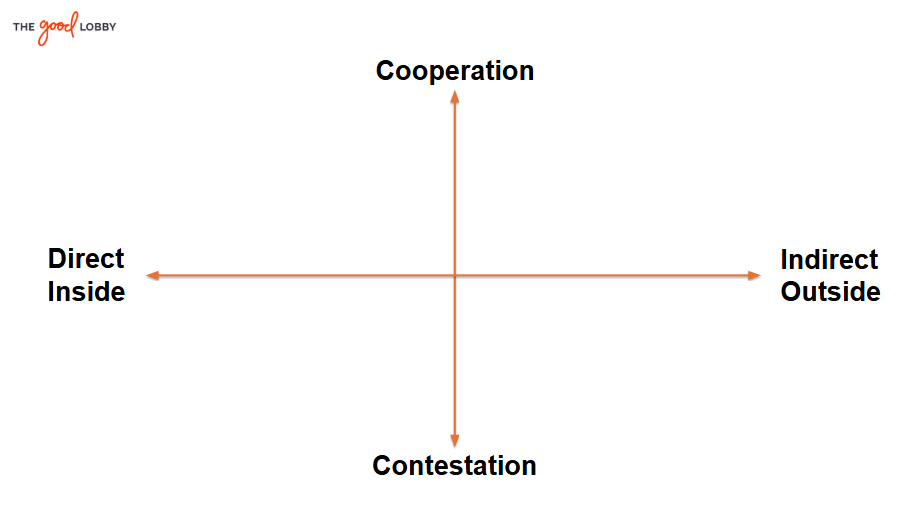
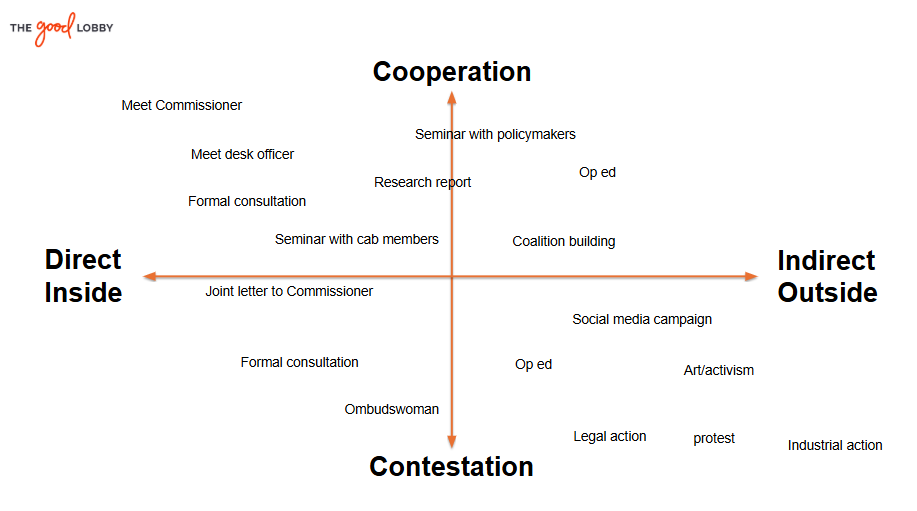
This mirror is useful in itself, and the act of acknowledging the differences between actions is not so simple, but it becomes even more useful when considered over time, in comparison to coalition partners or the opposition, or as a means to identify new and unlikely allies.
So instead of just plotting actions in terms of whether they are direct/inside, or the level of collaboration, of indirect/outside and their level of contestation, you can also get a sense of where you are tactically absent (or being pushed out – red arrow), and where you might want the profile of new allies to sit (blue arrows).
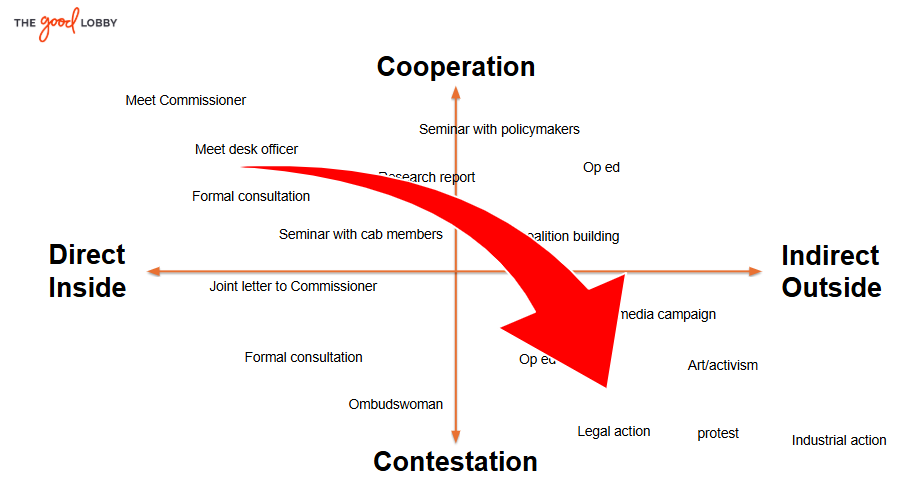
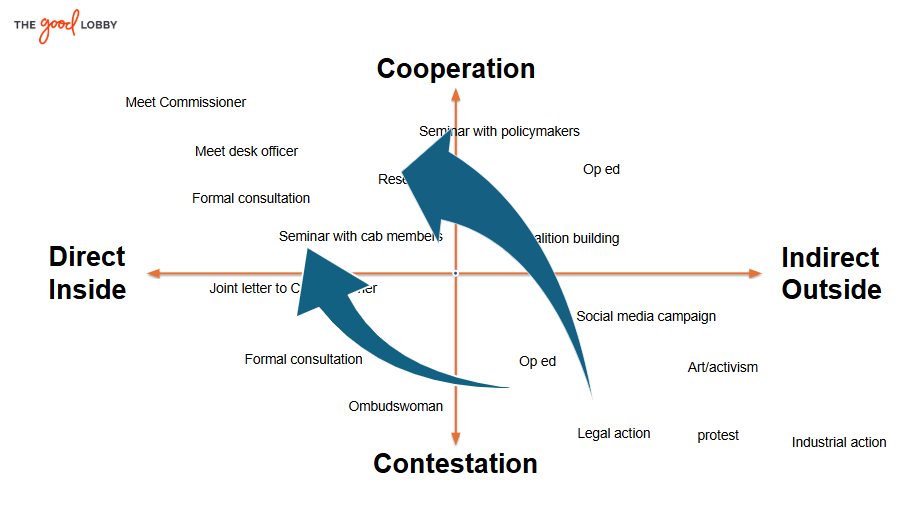
As politics and institutions change, our ability to influence and advocate effectively does too. In small organisations this self-awareness may come instinctively, and the shift to different methods just as naturally. In more complex organisations and coalitions, the advocacy mirror needs to be a deliberate assessment. If you know your own profile you then have a better sense of where you should seek allies to complement your advocacy. Allies are useful for solidarity and for building large coalitions, but when you are considering how to affect change in the context of change and uncertainty, it is unlikely allies that might offer the new edge to bring positive change.
Back to the turmoil. This all sounds nice if you have the time and resources to take a mountain retreat with your team. This is where private philanthropy should be stepping in. As foundations support grantees who are increasingly under stress, an honest conversation about advocacy profiles wouldn’t go amiss. NGOs need time and support to assess their organisational advocacy profiles – rather than just being expected to do more with less. This is a way to be more efficient with resources, more targeted with advocacy, and more discerning as they build sharp(er) coalitions with new allies.
And perhaps this might also be a moment for private philanthropy to turn that advocacy mirror on themselves: If they are engaging in the advocacy space, then where in the tactical grid do they sit, how do they complement their grantees, and are they being allies in this period of scarcity and regression?
Written by Neil Campbell