

06/11/2026
By Britt Vande Walle, Francesca Colli and Iskander De Bruycker, Maastricht University
Environmental NGOs have come under increasing political pressure in Brussels. Since the beginning of the second von der Leyen Commission in 2024, their legitimacy and use of EU funding have been called into question, with right-wing political actors arguing that public money should not be used to support lobbying activities. At the same time, corporate interests appear to be gaining ground in EU environmental policymaking, particularly in the context of the Commission’s growing emphasis on competitiveness and regulatory simplification, as exemplified by the Omnibus package.
These developments raise questions about whose voices are heard when EU environmental policies are being shaped. Do environmental NGOs really enjoy a privileged position in Brussels, as some political actors suggest? Or is access to policymakers becoming increasingly unequal?
In our recent policy brief, drawing on data collected as part of the ACCESS4ALL project, we examine how access to the European Commission has changed between the first and second von der Leyen mandates. Our findings suggest that environmental NGOs have lost ground relative to business interests. They also highlight an important, but often overlooked, aspect of the ongoing debate about NGO funding: rather than creating undue influence or privileged access, EU financial support appears to help sustain civil society’s ability to engage with policymakers.
Access imbalance?
Broad stakeholder consultation is important for both the quality and acceptance of EU legislation. By engaging with different interests, policymakers can draw on a wider range of expertise and better understand how proposed policies affect different groups. The European Commission itself recognises this in its Better Regulation Guidelines, which emphasise the importance of balanced stakeholder representation.
Yet, beyond formal consultations, it also matters who gets to speak directly to policymakers. Differences in resources and organisational capacity mean that not all stakeholders have the same opportunities to access decision-makers.
To examine these differences, we analysed data from over 8,500 organisations in the EU Transparency Register declaring an interest in environmental and climate policy. We linked these data to publicly available meeting records from DG Environment and DG Climate Action, comparing the first years of the two von der Leyen Commission mandates.
The results reveal a clear imbalance between environmental NGOs and business actors. Among environmental NGOs, a larger share had meetings only during the first mandate than only during the second. Nearly six in ten had no recorded access during either period, while just 17% maintained access across both mandates. Business actors, by contrast, display a stronger and more stable access profile. They are more likely to gain access during the second mandate than to lose it, and more than one quarter maintained access across both periods.
Figure 1. Stakeholder access to DG Environment and DG Climate Action
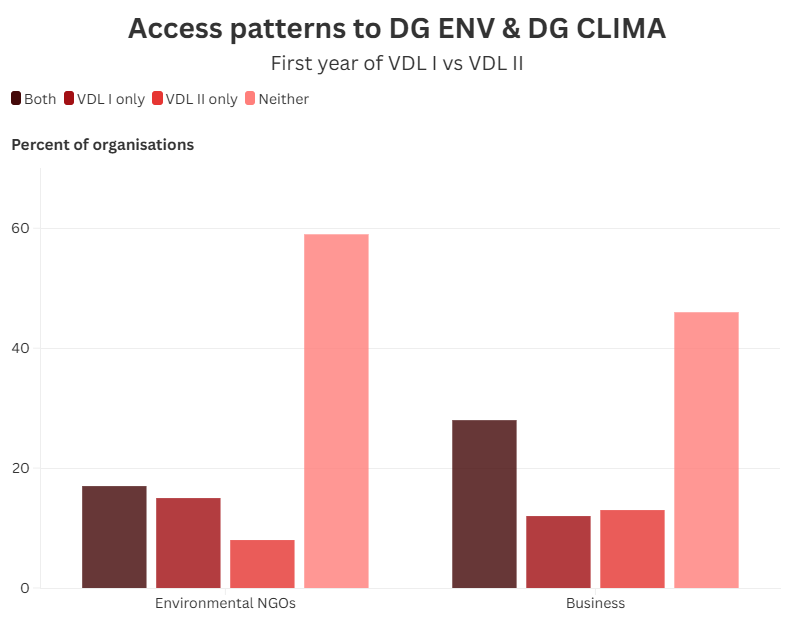
These patterns point to a widening gap in access between civil society and business interests. These findings are particularly relevant to the ongoing political debate about EU funding for environmental NGOs. We find that access to the Commission is closely linked to whether organisations receive EU funding. Nearly one quarter of EU-funded NGOs maintained access across both mandates, compared to fewer than 14% of non-funded organisations. NGOs without EU funding were also considerably more likely to have no recorded access at all and experienced a steeper decline in access between mandates.
Figure 2. EU Funding and Access to DG Environment and DG Climate Action among environmental NGOs
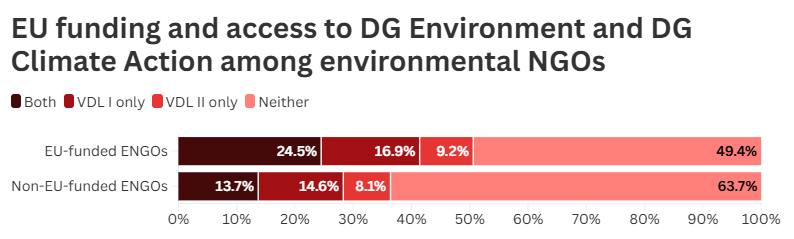
These findings suggest that EU funding helps sustain NGOs’ participation in EU policymaking, particularly in an environment where access is becoming increasingly unequal. In this sense, funding programmes such as LIFE appear to contribute to levelling the playing field among interest groups, rather than skewing it.
Why balanced consultation matters
What do these findings mean for the future of stakeholder participation in EU environmental policymaking?
First, they highlight the importance of safeguarding EU funding for environmental NGOs. Reducing financial support risks further weakening civil society’s ability to engage with EU institutions, particularly at a time when its access is already declining.
At the same time, funding alone is not sufficient to ensure balanced representation. Our findings show that non-funded NGOs face particularly significant barriers to access. The Commission should therefore actively reach out to smaller and less-resourced organisations through targeted consultations, rather than relying primarily on established stakeholders.
Finally, the growing political scrutiny of environmental NGOs makes it important to challenge narratives that question their legitimacy without sufficient supporting evidence. Such narratives risk undermining the funding mechanisms and consultation practices that enable civil society to participate in EU decision-making.
The EU has long recognised that balanced stakeholder consultation contributes to better and more legitimate policymaking. Yet our findings suggest that access to environmental decision-makers is becoming increasingly unequal. In a political context where environmental policies are highly contested, maintaining strong consultation practices and safeguarding civil society funding are therefore essential to ensuring that different interests continue to have a voice in shaping EU policy.