

9/7/2026
Every day, we – Europeans – rely on American digital services. We communicate through Meta’s WhatsApp, search with Google, collaborate on Microsoft, store data on Amazon’s cloud and increasingly rely on US-based AI tools from ChatGPT to Claude. As this unprecedented reliance on foreign infrastructures decreases Europe’s autonomy, what can Europeans do?
Europe already has competitive alternatives across cloud computing, collaboration software, messaging and AI, yet the real challenge is their adoption.
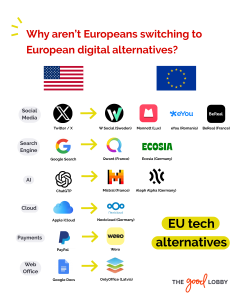
The challenge: adoption and scale
While they may not rival Silicon Valley in scale, European alternatives are slowly emerging, with the promises of offering organisations greater control over their data, stronger privacy protections and infrastructure rooted solely in European land, ruled under European law.
These services differ in number of users and market share, but they demonstrate that Europe is building an alternative digital ecosystem based on openness, interoperability and democratic oversight rather than platform dominance.
If the technology exists, why aren’t we using it?
The biggest obstacle is not the technological aspects themselves, but rather its users: we use WhatsApp, Instagram, Facebook, LinkedIn, etc. because our friends use it. Organisations stay with Microsoft because everyone else already uses Microsoft. Cloud providers become more attractive as more companies build around them. These network effects make it difficult for even high-quality alternatives to gain traction. Moreover, European digital ventures typically receive limited and fragmented funding, struggle to scale across borders and rarely benefit from the same public visibility as their US competitors.
Why do European tech alternatives matter?
Europe already has digital alternatives. What it lacks is widespread adoption. Digital sovereignty will not come from replacing every American platform overnight, nor from regulation alone, but through everyday choices, not only by legislators, but also by institutions and users. Public administrations could prioritise European providers when procuring cloud services or collaboration tools.
For civil society organisations, public institutions, and citizens, digital sovereignty is not an abstract policy concept. It affects who controls data, who sets the rules of online participation, and whose interests shape the technologies that increasingly mediate public life. Now, the EU’s challenge is translating regulatory ambition into technological capacity, because without stronger alternatives, sovereignty risks becoming an aspiration rather than a reality.