

13/02/2026
At this week’s meeting in Antwerp, industry representatives urged national leaders to commit to sweeping deregulation in the name of competitiveness. In doing so, they ended up pushing claims so exaggerated that they collapsed under their own weight. Once again, a familiar set of myths about EU regulation was deployed to justify rolling back common standards, weakening enforcement, and shrinking the European public sphere.
As argued by Professor Alberto Alemanno, these myths do not simply distort economic reality. They actively undermine public trust, weaken democratic accountability, and fuel Eurosceptic narratives. At a time when Europe faces multiple economic, social, and geopolitical challenges, this dangerous misdiagnosis risks locking the EU into a self-defeating policy cycle pleasing its enemies, be it Russian President Putin, former allies such as US President Trump and rivals Chinese President Xi Jinping.
Let us take a closer look at the five most persistent myths – and the mounting evidence that debunks them.
Myth 1: “The EU economy is falling hopelessly behind the United States”
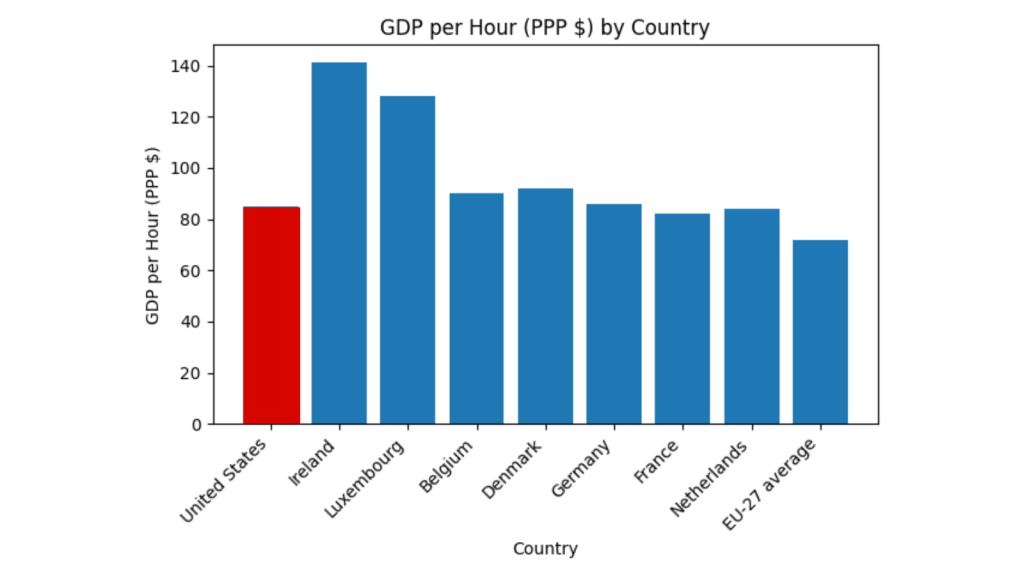
This claim has become conventional wisdom, but it is simply wrong. According to the OECD Productivity Database, several major EU economies – including Germany, Belgium, Denmark, Ireland and Luxembourg – match or exceed US productivity per hour worked, a core measure of economic efficiency (see: OECD Compendium of Productivity Indicators 2025).
The GDP gap between the EU and the US is largely explained by Europeans working fewer hours. As economist Gabriel Zucman has consistently shown, this reflects a deliberate societal choice prioritising work-life balance, social protection, and wellbeing – not economic failure. Europe’s economic model focuses on quality of life and long-term resilience. Presenting this as “decline” is misleading and ideologically driven.
Myth 2: “EU regulations only impose costs”
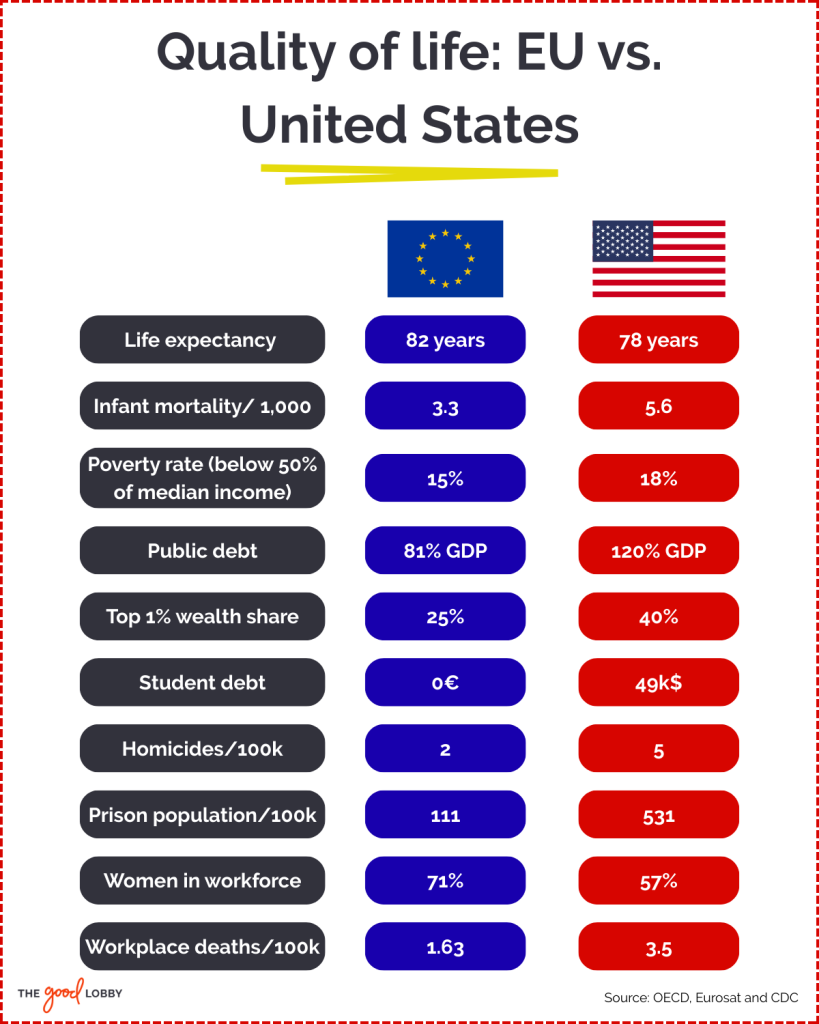
EU regulation delivers major social and economic benefits. Eurostat estimates life expectancy in the EU at 81.7 years, compared to 79 years in the United States, according to the US Centers for Disease Control and Prevention. Income inequality also remains far lower in the EU, with a Gini coefficient of 29.6 versus 39.8 in the US, based on OECD Income Distribution Database figures.
These outcomes reflect regulatory choices that protect public health, labour rights, consumer safety, financial stability, and environmental standards. As recent research and policy analysis have stressed, including by HEC Paris, dismantling these protections risks undermining Europe’s social and economic foundations. Regulation is not a burden – it is a collective investment.
Myth 3: “EU regulation stifles growth”
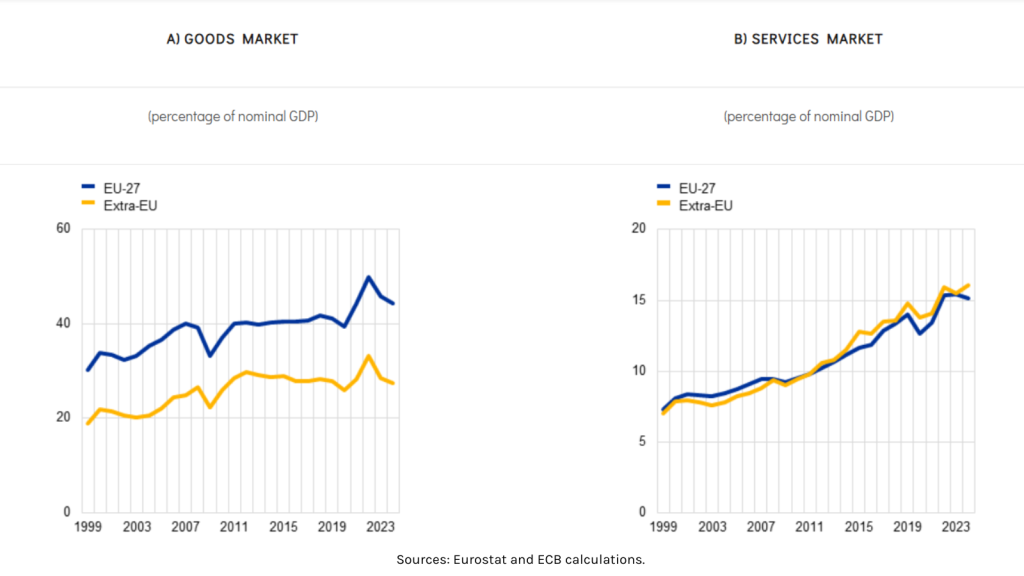
The Single Market demonstrates the opposite. By replacing 27 fragmented national regulatory systems with a single framework, it reduces bureaucracy, lowers transaction costs, and unlocks scale. According to European Central Bank research by Lehtimäki and Sondermann, the Single Market has increased EU GDP per capita by 12–22% since 1993, supports 56 million trade-linked jobs, and could deliver an additional 5–8.6% of GDP if fully completed.
Earlier analysis by the European Parliament Research Service similarly shows the Single Market remains Europe’s strongest engine of growth and employment. Fragmentation, not regulation, is the real obstacle to European competitiveness.
Myth 4: “EU rules aren’t fit for purpose”
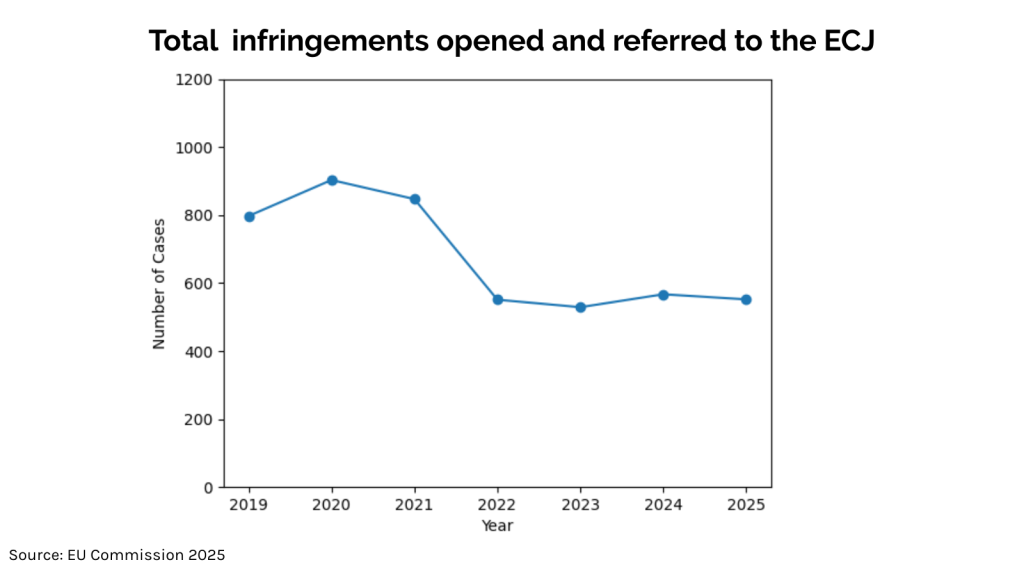
When EU rules fail, the problem is rarely their design – it is weak enforcement. Research by Daniel Kelemen and Tommaso Pavone shows that infringement proceedings by the European Commission against non-compliant Member States have declined sharply, reducing governments’ incentives to respect common rules.
This growing forbearance undermines the Single Market, rewards regulatory arbitrage, and penalises responsible firms. Without credible enforcement, common standards become hollow promises.
Myth 5: “EU regulation is to blame for Europe’s economic underperformance”
In reality, many of the most harmful barriers originate at national level. Governments maintain fragmented service markets, restrict labour mobility, and preserve divergent tax regimes. OECD data show that most Member States have increased restrictions on trade in services, weakening integration and productivity growth.
Instead of confronting their own protectionism, national leaders find it politically convenient to blame Brussels – reinforcing public resentment toward the EU while shielding domestic policy failures from scrutiny.
The real challenge: investment, not deregulation
The cumulative effect of these myths is deeply damaging. Meanwhile, the European Commission’s current “simplification” drive is expected to deliver savings of just 0.07% of GDP, while risking serious damage to democratic accountability, regulatory quality, and the rule of law – as warned by Professor Alberto Alemanno in Project Syndicate a year ago.
Europe’s real economic priority is not deregulation, but greater joint investment: in climate transition, industrial policy, public infrastructure, housing, education, and social cohesion. This is where public demand is strongest – and where political leadership is most urgently needed.
How long will national leaders keep blaming Brussels for barriers they maintain themselves? Even EU Commission President Von Der Leyen generally supine to EUCO’s demands, seems ready to denounce national leaders’ dominant narrative.