

28/05/2026
This piece looks at ‘ecosystem’ discourse and offers some waypoints and navigation advice for advocacy NGOs and their donors.
Written by Neil Campbell
Ecosystems are everywhere.
This is either a banal truism or an ecological epiphany. Some context might be useful.
In the non-profit, civil society and philanthropy space, you can’t go a day without multiple ecosystems creeping into conversations, not in the biological sense, but as a term of reference in diagnosis, process, relationships and resilience.
We talk about ‘progressive ecosystems’, ‘public policy ecosystems’, ‘civil society ecosystems’, ‘ecosystem analysis’, ‘ecosystem diversity’, there are ‘ecosystem junctions’, and we even cast our eyes out to the ‘far-right ecosystem’. None of which would satisfy a biologist’s hard-learned understanding of the word’s actual meaning.
In discussions and research on NGO advocacy, the funding for that advocacy across different sectors, from human rights to climate action, and the sustainability of those organisations’ activities, the ubiquity of ecosystem framing is striking. Sometimes it is just a turn of phrase, a simple and objective reference to a system of interacting actors and their environment, or a euphemism for ‘movement’ or ‘campaign’. But there are also moments when its use has more significance, and misunderstanding the meaning in its context has consequences.
It is worth an effort to unpack how it is used, what the nature, scope and substantive differences are, and how this might be helpful in the field of NGO advocacy and their donors.
Meaning and significance
The Oxford English Dictionary is a good place to start:
“A biological system composed of all the organisms found in a particular physical environment, interacting with it and with each other.
Also in extended use: a complex system resembling this.”
There may be no need to go further than this. Many conversations don’t require further clarity and just a general idea of what the ecosystem refers to is enough to move the conversation forward.
However, this objectivity does not last long. If you are in a discussion on an ecosystem (especially your ecosystem), it is likely that the conversation is trying to decipher or respond to one or more negatives in or around that ecosystem.
It is often used to indicate different levels of concern about the actor or ecosystem in question. There are arguably five subjectively negative angles that come up in these conversations:
- opacity – the ecosystem needs to be better understood;
- regressive/challenged – it has weak or increasingly failing elements;
- dysfunction – it includes dysfunctional relationships between the elements and/or their (political/funding/societal) environments;
- obsolescence – it needs new elements/actors;
- collapse – it is failing as a whole.
These are important and very subjective angles to be aware of depending on your perspective.
For example, if you are an NGO and part of an ecosystem discussion with a donor you need to be very clear where they are placing you on that spectrum – are you perceived as part of a failing ecosystem? Are you projecting yourself as a remedy for improving a dysfunctional ecosystem? Is your whole ecosystem failing? Is a completely different ecosystem in play that you have no connection to? And, as the donor in that conversation, could you be exacerbating rather than resolving those issues?
In a recent conversation one slightly exasperated participant asked a question about the scope of the ecosystem we were discussing. It was clear that there was no definite answer, just assumed knowledge of the topic in conversation.
A simple differentiation might be to contrast between micro and macro ecosystems and ensure the focus and guardrails between different systems is clear. Often the options of multiple overlapping ecosystems make this clarity difficult.
For example, in a discussion on the challenges of NGO advocacy on EU policy, the focus might be on NGOs and their reduced access to the European institutions. It might have a wider focus on a broader set of funders, foundations, institutions, NGOs and lobbyists competing for policy traction in Brussels. It might go further and be about the broader ecosystem of European public policy and the political shifts that inform political activities across Brussels and the 27 member states.
These layers go beyond a simple micro/macro division and more realistically fit into an application of the developmental psychologist Urie Bronfenbrenner’s ecological systems theory. While he focused on child development and the interplay of systems around a child’s growth, his differentiation between five concentric rings of micro, meso, exo, macro and chrono- systems could be applied to an individual NGO’s development and influence.
Bronfenbrenner’s microsystem of the family becomes the local communities and constituents of the NGO; the meso level – the interactions between the micro and societal factors – such as donors and governing institutions; the exosystem is the level where there are no direct interactions (in Bronfenbrenner’s model) but which nonetheless affect the subject, such as state or governing institutions; the macro level might refer to overarching global governance, geopolitics; and the chronosystem is how these interactions shift over time.
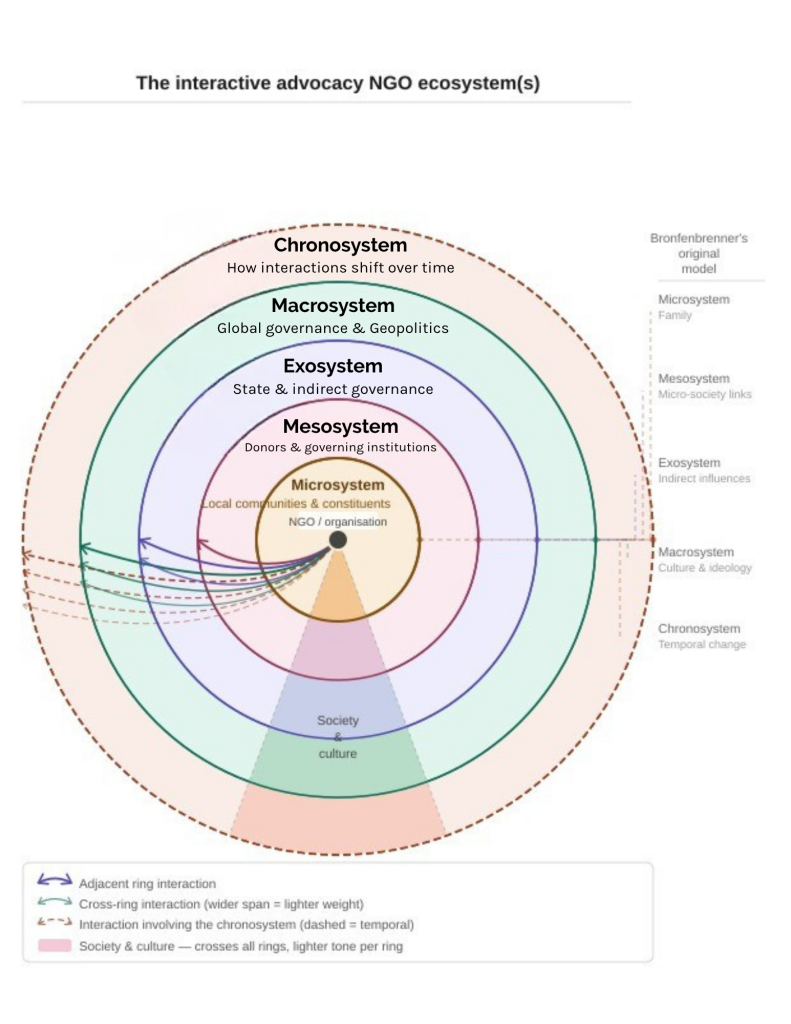
The lesson from Bronfenbrenner is simple but consequential: understanding which ecosystem level you are operating in matters, but so does understanding that the NGO is not merely a passive subject of those systems — it shapes them too. That bidirectional relationship is precisely where the health of an ecosystem is tested. And this also speaks to the NGO ecosystem with an advocacy flavour. If you take the 5 subjective negatives – dysfunctional interactions between layers is where advocacy sits, succeeds, or fails. This also begs a more pointed question: are the interactions between NGOs, their donors and their environments feeding the ecosystem, or feeding off it?
Other applications of systems theory from different disciplines might work just as well. And some organisations explicitly include an ecosystem or systems theory into their approach. For example the Children’s Investment Fund Foundation goes beyond support to individual organisations to “intentionally consider the ecosystem of organisations, people, ideas and platforms behind every issue we work on.” CIFF invests in “strategies that proactively nurture ecosystems.”
Attempts to decipher the specifics of each ‘ecosystem’ conversation also need to consider how responses to these diagnoses will have impact. We need to consider how solutions to problems affect the health of those ecosystems. This is where differentiation becomes more difficult. How do we differentiate between the type of ecosystem we are trying to describe, and the effects of the antidotes we are advising for the problems?
A partial answer came during the flag-waving crescendo of the inaugural Global Progressive Mobilization in Barcelona on 18 April.
The economist Mariana Mazucatto responded to a question on how governments might re-design their economies. She immediately raised the ecosystem spectre, but with a twist. She launched into a quick unpacking of how she borrows from biologists who differentiate between parasitic and symbiotic ecosystems.
My non-economist/non-biologist summary is this: A symbiotic economy feeds profits, dividends and capital back into the economy and society. A parasitic economy allows profits to be extracted away from societal needs. Mazzucato was imploring progressive activists to aim for a symbiotic economy (as introduced in her book, “The Value of Everything”, and expanded in “The Common Good Economy”).
The differentiation between parasitic and symbiotic felt familiar in the advocacy/NGO ecosystem not only because it might help decipher the ecosystem framing in consequential conversations, but also because it might shed some light on the impact of solutions that are applied to the challenges facing the NGO/advocacy ecosystem.
Symbiotic or parasitic?
What are the characteristics of both a symbiotic and parasitic advocacy ecosystem? Here are three possible symptoms of each.
The parasitic features of an NGO/advocacy ecosystem could be summarised as extractive, reductive or distractive.
For extractive, this might be related to the expertise, time and people engaged on a particular issue. Often donors are bringing activists and experts into their convenings to help guide their strategic discussions on how to apply their own resources. An exaggerated form of this becomes parasitic as the activist/advocate then becomes an expert in navigating strategic convenings, and is pulled from the community or advocacy they are representing.
For reductive, this might be the tendency to see an NGO as responsible for partial challenges or a dysfunctional ecosystem. Here the symptom is the NGO not the ecosystem in which it works. This is what happens when arguments used to denigrate or marginalise NGOs are repeated as fact. Similarly, if there’s a deterioration between donor and NGO that undermines the trust between them, there is a spiral of distrust and ultimately a breakdown in the funding. The most obvious reductive parasitic approach is the use of private lobbyists and public affairs agencies to maximise progressive wins in place of struggling NGOs. This may be an essential short-term strategic step, a win is a win after all, but this approach might not lead to longer-term implementation, power building or social capital (see constructive below). Unlikely allies are needed to help open closing policy tracks – but they are to augment not replace NGO advocacy (see The Good Lobby’s advocacy mirror approach and tactical grid).
Distractive responses might include the increase in short-term funding, the slow unexplained delay in funding, the strategy sheer as NGOs feel that any funding is better than none, and the heavy MEL and administrative processes applied to grantees. The NGO is not able to fully work on their strategic goals but are pulled in directions and processes that don’t necessarily feed into their aims. The donor report disappears into the donor’s system. The MEL analysis isn’t used to improve the strategy. The project funding doesn’t allow for organisational growth.
Parasitic gloom aside, what does a symbiotic NGO/advocacy ecosystem look like? These might be summarised as additive, adaptive and constructive.
On the additive side, many donors are trying to define and create an additional set of support elements beyond the actual funding. One philanthropy even refers to itself as a ‘donor+’, others promise a range of additional offers, from diagnosis updates, convening power, narrative change support, political access, power mapping. There’s often a support for ecosystem resilience and capacity building. These additional offers have to be wary of falling into the distractive/parasitic trap, but are generally welcomed, especially by those NGOs who don’t have the time or resources to go too far beyond their primary advocacy function. This requires an honest conversation between NGO and funder about additional needs (rather than extractive events or distractive processes).
The donor experience might also bring an adaptive strategic advantage to the NGO. If the challenges to the advocacy ecosystem are understood, and that includes difficulty of access or influence, then the support to go beyond traditional methods will bring the possibility of new influence and learning. Tactical diversity in the face of AI, information overflow and attention deficit is a necessity – and donor engagement at that level is catalytic.
A final symbiotic thread might be when there is a constructive approach to advocacy and influence by both NGO and donor. After a campaign has emerged with its coalitions and tactics, its timeline and deadlines, its inflection points and adjustments, its MEL and review, what is left? This question has echoes of whether funding for NGO advocacy, and the advocacy itself, is helping to build fields of actors, or deliver outcomes. It has to be both. There is a constructive dividend that falls somewhere between ‘advocacy wins that build power’ as long-advocated by the Center for Evaluation Innovation, and reinvesting the social capital of advocacy efforts and learning over time as supported by organisations like the Sheila McKechnie Foundation. The old dichotomy of field versus outcome focused philanthropy is equally relevant. But in terms of the constructed social capital across advocacy movements and organsations and its growth over time – the outcome is a vibrant advocacy field.
Ecosystems are under stress, everywhere.
Is the temptation to offer parasitic solutions a panicked response to ecosystem failure in part or whole, or a necessary response to achieve wins?
If we do not have any progressive ecosystem wins, will this differentiation between parasitic or symbiotic be moot as the progressive ecosystem fragments and dissolves into siloes?
These are big outstanding questions. As organisations deal with the challenges of political pressure, reduced funding and increased executive policy-making, it is important to ask these simple questions:
– what is the scope of the ecosystem you are referring to?
– how functional are the interactions within this, and with other ecosystems?
– what is your diagnosis of the challenges it faces? and
– are the proposed solutions balancing symbiotic and parasitic solutions?
If the donor-grantee conversation can start with deliberate diagnostic clarity and contours, that may be a more efficient exchange, and facilitate a more productive partnership. In that sense, ecosystem ubiquity might then be as much a pathway to success as it is a maze of challenges.