

14/09/2026
James Kanter‘s Keynote speech: “Who will be our truth tellers?” at The Good Lobby Summer Academy, held in Bilbao, Spain, on 20 July 2026.
Thanks Alberto.
I stand between you and a tall cold drink on the other side of the river. This makes this keynote a truly terrifying challenge. But here goes. So, first, by way of introduction, what I do: I co-founded and edit EU Scream, which is a non-profit, editorially autonomous mission driven project. We have streamed 130 episodes – including some amazing shows with Alberto. And we’re in the top 3 percent most listened podcasts globally. What’s the formula? We combine editorial standards of legacy journalism – I was previously with Dow Jones and WSJE and then 12 years with the International Herald Tribune and The New York Times. Combine that with the independence of civil society media – I got my start in non-profit journalism in Phnom Penh as chief editor of The Cambodia Daily newspaper. And then there’s the intimacy of audio – I did my first EU Scream recordings in a tent in my bedroom. So, as I say, intimate.
Let me also say we have a policy of not giving equal weight to mischief-makers and liars. Above all, we try to be truthful not neutral, especially about one of the elephants in the room: the threats to Europe that nativist forces represent. I strongly disagree with a lot of what the EU is currently doing. Or quite often not doing. But I remain loyal to the idea of having an EU. And that’s the spirit of my talk today.
OK, let’s get started. We still have a European Parliament and a European Commission. Both of their exteriors are currently draped with the word Democracy in giant letters. There are daily meetings and regular summits at the European Council’s Justus Lipsius building. All seems normal. But increasingly for many of us these glass and concrete edifices are physical reminders of an idea that is slowly being stripped of meaningful mission and inner
substance. Yes, the institutions can be functional and responsive – but they mostly seem functional and responsive vis a vis reactionary forces: like violent protests by farmers, or the demands of Big Tech, or to the panic among the EU’s majority of conservative governments endlessly running after voters they fear will go far right.
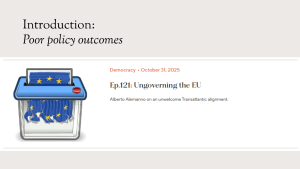
That means bad policy outcomes. And already today we’ve already been discussing one of the main vehicles for these bad policy outcomes — a great deregulation through the use of so-called EU omnibus laws. Or a great “ungoverning”. This is something Alberto and I have discussed on this highly regarded episode of the podcast. Ungoverning the EU.
And just to reinforce one thing here. What’s been so concerning is how von der Leyen is allowing herself to be pushed to bypass long established channels of evidence-based policymaking and proper democratic consent. One particularly startling example: here’s a video showing how farmers were successfully lobbying President von der Leyen to hollow out the Green Deal. This is early 2024.
I shot that video. It got 4.3 million views on X alone. Sure that’s where the farmers get a lot of support for their violence. But in a lot of other places, that’s not the case. And the way EU officials have been capitulating to coercive tactics has discredited the institutions and diminished trust in the EU among many citizens and business leaders.
First, I want to give some context about the far right and what should rightly be called the neo-fascists. The center right conservatives see these groups as what they are up against electorally. The far right live basically rent-free in every conservative’s head these days. Second, I’ll look at five narratives — polite and palatable narratives that those in power in the new EU – a more far right EU – are using in this new EU. These narratives show how the
EU is bending rules, compromising on fundamental rights, rolling back protections, kowtowing to MAGA, and betting on magical thinking to achieve growth. These also are narratives that big EU media outlets too often reproduce when they’d do better to be ringing the alarm.
To that point about media, I will then look at why it’s going to be hard to tell these stories better in the emerging media ecosystem. Yes, we need a more critical and plain-spoken communications environment. But who will be these truth tellers? Then some final thoughts. Do we compromise and strategize? Do we go into real opposition? We are after all in a serious situation.
Why still bother advocating for sustainability at the level of the EU when the EU so readily destroys its own sustainability legislation? How are corporate actors and philanthropists meant to operate when mainstream conservatives allow MAGA to bring lawsuits against them based on DEI and environmentalism? How can activists continue their work when the ladder is being kicked out from under them both in terms of funding and legality? And how are we supposed to be journalists when our big brand media outlets discard the elemental guiding principle that long underpinned journalism: to afflict the comfortable, and to comfort the afflicted?
First, that context about the far right.
So in my work I’ve zoomed in on two overlapping explanations for how the far right seems to have exploded in popularity and now is hard to shift. These aren’t definitive or exhaustive explanations by any stretch of the imagination. But they’ve helped me a lot in trying to make sense of why the radical right has become an effective narrative shaper.
First, the far right and its cultural strategy. I released an episode with a similar title last year that is reupped here.
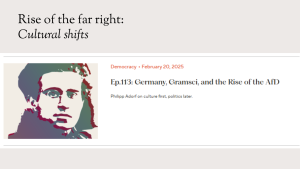
The main point here is that the far right has been playing a long game of culture first, politics later. The question was posed by the Nazis and fascists in 1945: how would such ideas ever gain public acceptance ever again? A big step was the founding of ethnonationalist think tanks in the late 60s and 70s for spreading racist ideas. For that podcast, I spoke to a Bonn University academic, Philipp Adorf about this cultural strategy in reference to the AfD, the neofascist German party. Philipp introduced me to the term Vorfeld. That is the German word for vanguard, a vanguard that in the case of the AfD has for a couple of decades really been preparing Germany for a far-right future. The main idea has been to make what was seen as an absolute evil after WW2 —mass deportations including “remigrating” citizens deemed insufficiently integrated — into something that many of them now are prepared to vote for. In fact, the European far right is even more engaged than ever in this “remigration” campaign.
In July there was a meeting inside the European Parliament where these far-right activists – invited by far-right MEPs – were celebrating progress in their multidecade plan to push out non-whites from Europe. I even heard Dries Van Langenhove – this is the twice convicted Flemish far right activist – use the expression “metapolitical victories” to describe how the vanguard (Vorfeld) is pushing the EU migrant crackdown forwards. And this metapolitics language – focusing on laying the groundwork socially and culturally, rather than focusing on electoral politics – that language is pure Gramsci, Antonio Gramsci, for those of you familiar with his work.
There’s a second interesting explanation I’ve come across for how this change in our politics arose: this focuses less on culture and more on political opportunism — political entrepreneurs who use crises to alter voter decision-making.
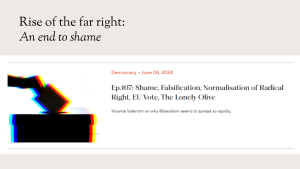
This conversation is one of our most listened episodes. It’s with Vicente Valentim. He’s an Oxford and Barcelona academic who explains why the hard right has managed to break through so rapidly in recent years. I based that episode on his book, The Normalization of the Radical Right. Vicente’s core idea here is how voters were encouraged to lose their shame – shame at expressing extremist viewpoints about migrants, progressives,
environmentalists and globalists. The change was rapid because political entrepreneurs, Trump, but also Farage, and even Meloni, and so many more, tapped the intensity of current events to activate latent anxieties and prejudices within voters, including some formerly on the left. This process picked up speed after the 2009 financial crisis followed by the migration emergency, the terror attacks, and the pandemic. And we ran this episode against the backdrop of the 2024 European Parliament elections that delivered more seats than ever for radical right lawmakers. What’s important here is that the shame once associated with voting, essentially, for neo-fascists, now is gone. Polarisation in that sense is locked in. At least for a long while.
It’s important to talk about the far right because – again – unfortunately they are often making the weather. The mere presence of a moderately strong far right has been very impactful as a radical flank, a radical flank which makes an only more marginally moderate policy look reasonable and safe by comparison. This is how the famous Overton window moves, even when the vote doesn’t. Centrist and conservative governments may still win elections. But they feel pushed – in some cases – to adopt some previously unthinkable positions. And this is reflected in some of the narratives – polite but unrealistic narratives if you like – that allow Brussels to function as if everything was somehow normal.
Narrative one: there is an acceptable far right.
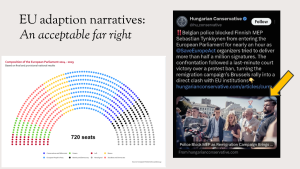
Now, it’s critical to understand where this came from. Ursula von der Leyen was voted back for a second term in 2024 by the nominal center in the European Parliament: the center right, the social democrats, the liberals and the Greens. She did not need the backing of the far-right Brothers of Italy or the Polish ultraconservatives. But when von der Leyen and her fellow conservatives reassumed office, when their second term began, they saw they still could use that group, the Meloni-Polish group, known as the ECR, to pass right-wing legislation. So, she pulled a sly trick: She designated the ECR as a form of non-toxic far right. Safe to do things with. On the basis that they supported Ukraine against Russia while those further to the right, Viktor Orban’s group and the AfD group, did not. The bottom line is that for the first time, the EU’s centre-right openly discussed the conditions for cooperating with far-right parties.
Now, in reality, all three far-right groups including the ECR have a lot in common, from xenophobia, to distrust of state institutions, and a fixation on free speech. But the most important incoherence in von der Leyen’s strategy is that the ECR has a lot of members with ties and sympathies with Russia. These include the pro-Russian Alliance for the Union of Romanians; George Simion, the pro-Kremlin Romanian who nearly won his country’s presidency, is executive vice president of the ECR’s political party. There’s also Nicolas Bay, convicted for misusing EU funds in the Front National assistants’ affair and known for Kremlin sympathies. Also troubling for different reasons: Finnish MEP Sebastian Tynkkynen, one of the leaders of the identitarian remigration campaign; and Estonian MEP Jaak Madison who has defended aspects of Nazi Germany. Just to name a few. But this group now is so normalized that Brussels media and think tanks accept ECR without qualms and only talk about whether the two other far right groups, the Patriots and Sovereigntists, should be excluded or included in big jobs in the future. Long story short: von der Leyen still enjoys the legitimacy of the center while governing, making legislation, from the far right. And the old cordon sanitaire, the old firewall, with the far right exists in name only. The selective respectability granted to the ECR has blasted the way open to an even broader normalisation of the far right.
Narrative two: the EU still is planning for humane control of irregular migration.
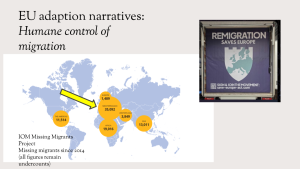
Humane treatment of migrants is the message we are meant to take away when the EU talks about border controls. Go to any EU press conference on this topic and it’s the smugglers who bear total responsibility for the migration phenomenon. And as for that apparently cruel behaviour by the Greek coast guard? Just occasional overreach; and Frontex, the border and coastguard agency, which is the EU’s biggest agency by far, still is fit for purpose, despite, in some cases, being unable to intervene to stop mass drownings. The EU says there are falling irregular entries and rising organized deportations. That, it says, shows its migration policies are working; that’s also justification, they say, for giving Frontex around 1.5bln euros annually, up from current figures of around 1.1bln euros annually, and increasing the Frontex corps to 30,000 agents, up from current numbers of around 7,000.
In reality, humane management of migration fell apart a long time ago. The penny dropped for me when the European Commission wouldn’t even push back on The Great Replacement conspiracy theory being touted by Frontex’s former executive director. Fabrice Leggeri since joined Le Pen’s party and is an MEP. The latest development is the deportation regulation: EU member states are planning to pay countries in the Western Balkans and North Africa – not just to hold migrants back but also to accept rejected migrants from Europe. Europe can’t credibly style itself humane while outsourcing human beings to countries with poor human rights records where they have no connection. Furthermore, last month, legislators in the European Parliament chanted “send them back” while approving those plans and it’s that kind of violent rhetoric that raises urgent questions about the future. “Send them Back” is a chant associated with MAGA in the US and the European identitarian movement that now is pushing a quote “Save Europe Act” and an EU-wide “remigration” system. This would effectively sort who belongs in Europe by ethnicity for a white and Christian continent. As for those falling numbers of irregular entries: the more important metric is probably how the first few months of 2026 were the deadliest in a decade on the Central Mediterranean Route, which already is the deadliest migrant crossing in the world. Meanwhile private rescue operations at sea are being criminalized, and this of course further reduces search and rescue capacity.
I think we are rapidly approaching a moment where people even remotely concerned with fundamental rights will have to choose whether to support or reject an increasingly hostile and even murderous anti-migrant policy.
Narrative three: the EU has a viable plan to avoid US and Chinese tech dystopias.
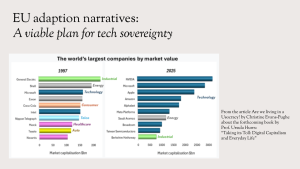
The EU’s story on tech goes something like this: that it has long been a strong enforcer and that it’s actively creating a model that’s neither American, where corporations effectively set the rules, nor Chinese, where the CCP uses tech to entrench authoritarianism. Just look at von der Leyen’s plans to protect children online. That approach, if you read recent Brussels commentaries, could pave the way for broader and more muscular regulation of Big Tech. In this reading, Brussels is not caving into vicious US lobbying but is engaged in judicious lawmaking that can eventually achieve tech sovereignty. That includes getting into the AI race with subsidies and making it easier to build datacentres.
OK, for a dose of reality: this chart shows the challenge. It shows the world’s largest companies by market value. The colours represent different sectors. The chart compares 1997 with 2025. And there’s this astounding shift. In 1997 two tech companies, Microsoft and Intel, are in the top 10. Last year 8 out of 10 are tech companies. With Nvidia, Microsoft, Apple, Amazon, Alphabet, and Meta taking the top six spots, and all of them deeply involved in AI. Looking at Europe specifically: Google, Microsoft and Amazon – which already have 70 percent of the cloud market in Europe – will still be allowed to host sensitive EU data. That’s serious because that data still can be accessed by a hostile US administration. Meanwhile Russian propaganda, islamophobia and antisemitism are running riot on Musk’s X social media platform, with bad things happening on Zuckerberg’s Meta platforms too.
This wasn’t the plan.
There is the Digital Services Act, the DSA. But the EU is not standing up to US pressure to pull its punches. And it’s much the same story for the AI act: it’s been delayed and diluted too. There’s also the supposed imminent collapse of Europe in the deliberately alarmist and highly speculative Europe 2031 report authored by European AI boosters with close links to the tech industry. Talk to this crowd or talk to officials who’ve been bamboozled by the breathless lobbying, and the idea of facilitating “technofascism” by enabling AI for everything is somehow seen as absurd. But it’s not absurd. The AI bubble could burst, turning the AI buildout into a giant liability and ushering in an era of austerity that would favour fascist parties that thrive in periods of economic hardship. Then there are the radical right US tech oligarchs already giving European states and security agencies the tools, via companies like Palantir, to reinforce creeping authoritarianism in exchange for contracts and favourable treatment.
The prospect of mass surveillance and social control, enabled by AI, and powered by data centers that gobble up increasing amounts of our energy and our water – all this makes a tech dystopia a real enough prospect for Europe.
Narrative four: the Green Deal was “naïve”
The EU says the Green Deal wasn’t working because the rules were making Europe uncompetitive. The latest iteration of this narrative is as follows: that we must dial back ambitions for the carbon market even though it’s been our main tool for fighting emissions. It now looks like industries will be allowed to receive free pollution permits well into the late 2030s. When it comes to the chemicals sector, the sector has convinced the EU that it will die unless it can keep using substances deemed harmful. For example, mandating PFAS-free alternatives would be too disruptive. Besides, the climate conversation has refocused on issues like air conditioning and other purely adaptive responses to dangerously hot summers. In a polarized political environment and with cost-of-living concerns, the EU says it can’t be expected to advocate for staying the original course on mitigating CO2, and for introducing supply chain liability, and for mothballing fossil energy sources. And it’s the same with the car industry: Germany said sticking by the ban on combustion engines would only help drive votes to the AfD. As for buying even more liquified natural gas from the US? Well that’s strategic, and at least it’s not Russian gas.
OK, let’s unpack this. Much of the Green Deal hadn’t even gone properly into effect. Yet it already was being branded as uncompetitive. It also turns out that pressure to kill major parts of the Green Deal came from a well-documented alliance of mainly US companies. So, rather than its supposed unworkability, it was in large part a giant cave-in to industry lobbying that really killed this signature example of EU regulation. As for reversing a ban on the combustion engine, is that really going to help Germany navigate the 21st century? Besides the AfD keeps getting stronger anyway. And importing even more LNG? That means building more LNG terminals that represent sunk cost commitments to fossil fuels. And then what about the carbon markets? Yes, a carbon price raises the cost of burning gas and coal to make electricity. That’s after all the point. But Brussels has done little to push back against enemies, like Italy’s leadership, of the carbon markets; instead, Brussels could have steadfastly made the case for how carbon markets help lower emissions and deliver revenues. Maybe the most relevant right now, beyond the wildfires that are ravaging Spain and France, is how Europe remains vulnerable to energy shocks due to the ongoing conflict in the Gulf. That’s the result of ongoing reliance on fossil energy imports. In conclusion: what’s naïve has been to jettison Green Deal commitments that would radically decrease dependencies on third countries.
Narrative five: military spending will grow the Eurozone economy while making us safer.
What the EU says here is that the very real and acute security crisis in Europe (Russia’s full-scale invasion of Ukraine, Putin’s threats to the Baltics, Trump’s threats to abandon NATO and to pull back US troops) are an opportunity to ignite a long-needed growth stimulus. It’s certainly true that Europe is already the main contributor to the global increase in military spending: 2025 saw a 14 per cent rise to around 800 billion euros. Germany was the largest spender, up 24 percent to around 100 billion euros. The argument you often hear is that this will mean faster-than-expected GDP growth through the rejuvenation of national industry thereby raising living standards and adding skills. In other words, higher defence spending will not only shield the continent against new threats but also generate much-needed economic growth — especially in those areas hit hard by the decline of traditional industries. This is a very fanciful narrative indeed. As to growth effects, it turns out defense spending usually has a limited impact on output. Investing in transport infrastructure, the energy transition, or education — those are usually better bets. Even then, to have an impact, Europe would need to shift from buying weapons designed and mainly made in the US, to home-grown innovations. But Germany and Poland among others say there’s no time to develop European systems, and they keep on buying from the US. They may be battered and bruised by Trump, but many European policymakers stick by the idea that there is a US security guarantee in the form of US troops and US nuclear warheads, and they are above all guided by the fear that buying less American weaponry will impact US political perceptions. This has all left French president Macron fuming. He has started a conversation about how France could Europeanize its nuclear weapons technology. But there are problems there, too. France may soon elect as president Marine Le Pen and she has already rejected the idea of joint European nuclear deterrence with EU allies. And one last point here about European rearmament as some kind of panacea. Many young people are very hacked off when they see money for guns but not climate or education. They also are apt to wonder whether the rearming to defend the oft-touted rules-based liberal international order is a form of hypocrisy, since it’s precisely that order that has tolerated and even supported Israel’s crimes in Gaza following the murderous attack by Hamas. Being pro-Palestine and antimilitarist has become the common sense of a generation, and I don’t think we should underestimate what that means politically.
So that’s just a small selection of narratives that are very common, frequently reproduced, but that are seriously problematic. They are meant to be illustrative of a larger issue, that the way our stories are being told are incomplete – even papering over complicity with fascistic forces at work in our politics and economies. One might ask: where are the banner headlines yelling about Christian Democrats allying with full blown neo-Nazis? Or about Brussels running scared of Zuckerberg and Musk? And why are we now buying more, not less, fossil fuels from America?
OK. So next I want to consider who — from traditional journalists to influencers and civil society and so on — which of them might be best placed to do a better job in this era of epochal changes in politics, technology, security and the climate.
Starting with legacy media.
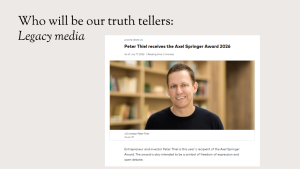
And let’s start with the latest: Politico’s parent company Axel Springer of Germany just announced it would give its annual prize to Palantir billionaire Peter Thiel. Peter Thiel is one of the PayPal billionaires who was an early supporter of Trump, who has bankrolled JD Vance, and who literally said: “I no longer believe that freedom and democracy are compatible.” He believes that a cautious approach to AI and promoting financial transparency, climate action and multilateralism all are the work of quote, the antichrist. He also credits Nazi jurist Carl Schmitt for helping him craft his belief system. This decision by Axel Springer can only further raise suspicions that another big mainstream media company – but this one being the one with the most influential footprint in EU news – will veer toward reactionary politics under pressure from its ownership. That’s already happened to some degree at The Washington Post, where owner Jeff Bezos of Amazon has imposed a rule that the newspaper must consistently advocate for personal liberties and free markets.
Now, let me be clear. These kinds of publications boast very highly trained and experienced reporters and editors. They use the tools of professional journalism to find the truth on our behalf. But you might well say, hang on, a lot of startup media seem to be able to do that too. True. But startups often aren’t big enough to that work consistently and fight lawsuits including litigation designed to harass and silence. So, losing these big companies to the extremes is serious on a number of levels. But beyond the horrible decisions being made by these companies’ CEOs, I’d also critique the legacy media for already being too ready to go with prevailing narratives. They still primarily feel dutybound to report on who’s in power and what they say. But here’s the question: can that time-honoured approach ensure that we keep a free press?
We now have governments in office that although they won democratically, now intend to stay in power by cheating or dismantling checks and balances, and that includes of course attacks on press freedom. And let me say something about legacy media reporters in Brussels in particular. You often hear from the right that media is left-coded. And that journalists as a species are left leaning. Well, maybe. But in Brussels, I don’t think so. A lot of journalists are so deep into their policy fields that, even if they began left-coded, they kind of end up right-coded: essentially taking the sides of the lawyers and lobbyists who tend to be their sources for leaks and angles. I know how this works: once upon a time I was a specialised antirust reporter for Dow Jones and the Wall Street Journal Europe. You also might ask: why did the Brussels media turn up to a US “Freedom 250” party last month in such substantial numbers even though the diplomats hosting the event and one of the main entertainers endorse Trump’s white supremacism and disinformation about Europe? Why did the Brussels media have no real qualms in quoting MCC Brussels (that’s the Orban-aligned think tank that new Hungarian Prime Minister Peter Magyar now is trying to shut down) even though it was funded by revenues derived from Russian oil and advocates MAGA-style bigotry?
Long story short: too many news outlets are still covering threats to the EU and democracy like politics as usual. But news is democratic infrastructure – if there’s no real democracy, there’s no real media – and I think the media should behave more with that in mind. That means covering the EU bubble more the way media covers backsliding democracies. Instead, we are all too often being fed microdoses of proto fascism. Next, public media. Like RAI in Italy, ZDF in Germany, TVP in Poland or the BBC in Britain.
They all face problems, but let’s focus on France.
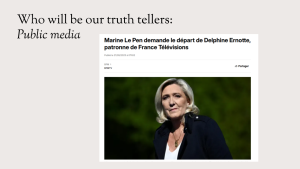
That’s where the head of France Television is warning that her media could be dismantled if Marine Le Pen wins next year’s presidential election. Those fears are well founded because a favourite talking point of the far right is how public broadcasters use taxpayer money to promote a progressive agenda. The truth is of course that populists want to get hold of public media for themselves – by making the funding directly linked to political approval, or by parachuting in their own managers, and even litigating, but always with the same rationale. Control.
This was clearly articulated by Viktor Orban – who imposed strict controls on state media – and who famously said four years ago: “Have your own media. It’s the only way to point out the insanity of the progressive left.” Since Orban was kicked out after 16 years in power, the Hungarian state broadcaster has apologised for its past lies. So, on the plus side, these are large institutions and they can recover after a period of capture. But the question now is one of survival. One of the main talking points of the radical right is: why support public media with public money if they aren’t as popular anymore? That, says the far right, would be rewarding failure. The far right says it’s not their fault if their podcasts and viral videos and carnival barkers are better at engaging audiences. So the question really, is how to hang on to ways of making content in the public interest? Yes, the EU has a Media Freedom Act, but it seems to have neither the energy nor scope to use it. That squeamishness over enforcement is yet another reason for thinking the European Commission is losing its way. In the meantime, public media still is being dismantled or under serious threat in many places including Greece, Czechia, Slovakia and Italy. One bright spot is the nonprofit, cross-border investigative layer. One can think of groups like Lighthouse Reports and Follow the Money. I have worked with Lighthouse Reports. It was a podcast on lobbying by the meat industry, and it was a great experience.
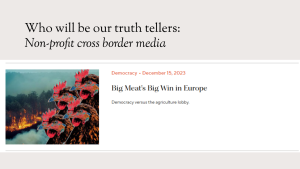
They are as meticulous as lawyers with a laser focus on generating a public response. But they’re not a sustainable model in and of themselves. And they still largely rely on legacy media for distribution. They will need more philanthropic support. And they make a good case, that a key means of strengthening free media in these times is greater coordination, deeper partnerships, and more strategic collaboration. There is a lot to this. But the philanthropy would need to be big and sustained if the collaborative layer is to stand on its own and really pay decently.
And let me say this too: so many journalists these days are basically working hand to mouth: over-committed, underpaid, accepting rates that are way too low, because they are afraid to decline work. Burnout and gradual demoralization are very real phenomena. On the other hand, some of these writers may not be submitting articles in the language their most comfortable writing in, or they may still be trying to get a foot in the door of journalism and don’t have that much experience writing clearly and grammatically. Of course, generative AI is a bit of a leveller here, but then you get into the ethics of using the technology to help with original content. Basically, AI is a double-edged sword for journalism, and in several ways. For example, AI is generating the synthetic content flooding the information space — the number of AI-enabled news sites operated by little or no human supervision has increased hugely, with many of them vectors for fake news and disinformation. On the other hand, AI is the fastest-growing tool civil society and journalists have for verification, monitoring – and of course editing.
Next up influencers and creators.
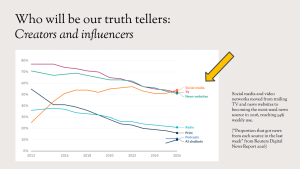
Let’s again start with the latest: the Reuters Institute’s 2026 Digital News Report, which found that audiences now get more news from social media and video platforms than from news sites or publishers’ own apps. A milestone. Influencers and creators aren’t yet replacing traditional news media outright but there is a turn towards individual names and faces for news, and a turn away from outlets with big and fancy brands. So, what does the arrival of influencer/creator content mean for the quality of our communications ecosystem? Journalists are working for what they define as truth – and some are becoming influencers. Influencers are working to create a community they can monetize – and some are becoming journalists. These things obviously can live together and they will do so. But there are issues. First, we see that right-wing shows have several times the following compared to centrist or left-leaning ones. Also, the model is broadly unsuited to accountability journalism where you can get sued or persecuted by powerful individuals and entities. And then there’s how democracy can’t rely on ever larger numbers of personalities emoting to news gathered by fewer and fewer people. Plus influencers can be turned into disinformation vectors.
Two thoughts: first, make the big social media platforms and big podcasts subject to the same editorial rules every other sort of media is: strict content standards, political advertising parity laws, and liability for defamation. Joe Rogan can get it wrong all day long with impunity and that shouldn’t be the case. Second, because influencer/creator content is absolutely 100 percent where attention is headed, I think this must become a particular vector for philanthropy: to help good journalists become bigger influencers and – perhaps more importantly – to help the big influencers become more factful communicators. It’s not enough to rely on legacy news organizations to try to turn their reporters into authentic voices. It’s just my view, but I think the big stars already out there are more relevant. So, boldness is required. And seeing philanthropy engage with this sector would be a sign of positively riding a wave of radical change, rather than trying to contain it.
Next CSOs. In some ways civil society organizations are doing the best work of anyone. They are the ones standing up to corporate interests and authoritarian creep.
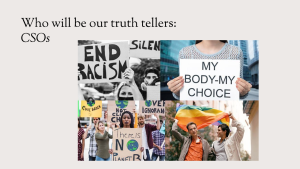
And for that they have been facing an international witch hunt by the right and far right. At the level of the European Parliament, they have been subjected to a so-called NGO scrutiny group, a sort of McCarthyite body. This is essentially lawfare by the right against civil society that’s already under pressure from cuts to USAID funds, the withdrawal of Soros’s Open Society Foundations from funding NGOs in Europe, and now the way MAGA is attacking philanthropic giving. The right’s allegations boil down to the idea that NGOs have used EU grant money to carry out lobbying activities at the behest of the European Commission. But there’s been no real evidence of that presented by the right. And even some conservatives think it’s ridiculous to single out environmental or civil rights NGOs. After all, the EU doesn’t just fund NGOs, it also channels funds and subsidizes corporate actors whose work the EC thinks is valuable. Besides NGOs have just a fraction of the financial firepower of industry and corporates, and they get far fewer meetings with the European Commission. That said, many NGOs are in my view too focused on this access. They need to become more adversarial. Another issue: civil society groups still are claiming wins when they are frankly non-events or even setbacks. This kind of messaging feels detached from a political reality that’s moved very sharply against them. (One triumphant email I saw recently proclaimed: “We’ve overtaken Big Tech!” after winning a single meeting with European Commission cabinet officials. This is plainly ridiculous). CSOs have decades of inside track engagement with policymakers; but they may need to shift gear to an outside track that’s far more oppositional. And they’ll need to turn that into an approach that gains traction with funders.
Let me wrap up.
We no longer live in democracies that function as they used to, especially in the United States but increasingly in Europe. This paradigm shift still is something we are coming to terms with. The narratives used by our leaders may help them govern day-to-day, and they may even ease their consciences, but these narratives aren’t helping us see clearly what’s at stake. What’s more, media too often reinforce these unhelpful narratives rather than challenge them. This mismatch between political reality and political rhetoric is I think an important backdrop to our discussions this week.
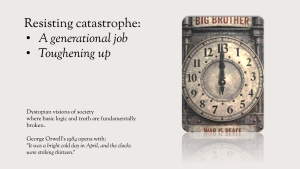
Acknowledging that the situation holds great danger is important. And yes, it does seem like basic logic and truth are fundamentally breaking down. But I want to add an important caveat here about how dystopic visions of society quickly become unhelpful. Yes, dystopic narratives do have seductive pull. But we are not living a full-blown sci-fi disaster movie, or under authoritarianism, and we’re not yet being forced to become interplanetary species. The clocks – to echo George Orwell, from 1984 – are not yet striking thirteen. The death of liberal and social democracy is not a foregone conclusion. The real danger is treating catastrophic scenarios as inevitable, rather than a call to act. The spur to action actually can be sought in darkness, as Rebecca Solnit has so eloquently explained: “Hope is an embrace of the unknown and the unknowable, an alternative to the certainty of both optimists and pessimists. Optimists think it will all be fine without our involvement; pessimists adopt the opposite position; both excuse themselves from acting.”
We also need to realize that the work of shoring up liberal democracy could be a generational job. Nobody serious I’ve spoken to thinks we should expect a near-term turn away from the fascistic virus. After all it took the Hungarians 16 years to overthrow Orban democratically. But they got there. And we too may need to plan for the world we want to see emerge in a couple of decades. Indeed, we may have to do some of that Gramscian “metapolitics” that the far right has adopted, e.g. shaping culture, language, and ideologies to change how the public perceives the world. As to the civil society PR model of loudly proclaiming nonstop wins? Well, there may not be significant wins for a long time to come. In the meantime, many more of us, from think tanks to academia and journalism, could take inspiration from the earlier civil rights movements: to tap into the moral necessity of resistance in the face of what seems impossible odds, rather than base our actions on a quest for immediate and tangible outcomes.
The realization that this is a long struggle may make going into opposition easier for some people, harder for others. I appreciate how going into real opposition – for example openly advocating for the removal of Ursula von der Leyen even if that risks EU funding and political preferment – will require difficult trade-offs. There are those who say going into real opposition would mean giving up on trying to keep EU’s current leadership democratic; they say we mustn’t give up on using influence and access to mitigate even worse outcomes. Equally, there are plenty of people who say adopting an insurgent posture is the only way ultimately to build a majority; a majority that’s genuinely progressive and aligned with our finite planetary boundaries.
I don’t have the answers of course. But what I do know is that, either way, we will need to toughen up.
I’ll leave it there.