

27/02/2026
This piece breaks down the daily tasks and deliverables of advocacy teams, how they combine, and why funders and advocates need to understand them – especially in a time of scarce resources and political pressures.
The perennial question: What is advocacy?
After an initial intake of breath, the response is never an answer, but an attempt to clarify the question through some simple sub-questions: Do you mean, how does the EU define ‘advocacy’? Or, how does each NGO understand their own advocacy profile? Or maybe, how is advocacy measured? Or, what’s the difference with lobbying? But the one advocacy sub-question that is often glossed over is this: what do advocacy teams actually do?
This is a question about the practical activities that make up the building blocks of an advocacy team. What are team members tasked with doing and delivering, and how are those deliverables then communicated beyond that particular advocacy unit or organisation? As civil society navigates scarce funds and regressive politics, there needs to be deep, honest and perhaps painful deliberations on this (sub)question.
Three different meanings of the word ‘scale’ might help unpack what advocacy teams do, and offer implications in a time of stress and change.
For the purposes of this attempt to decipher advocacy activities, ‘scale’ could refer to: 1. a sequence of elements; 2. the mechanism that assesses the comparative weight of those elements; or, 3. as often happens in Brussels, it could refer to fish.
First, the sequence of elements. Often, when advocates are asked what they actually do, we will offer a collection of activities and outcomes that range from information gathering to meeting officials and everything in between. The variations are multiple and confusing. As advocacy comes under increased pressure and scrutiny, it might be useful to consider a back-to-basics, non-exhaustive list of the activities undertaken by staff who are employed in advocacy teams.
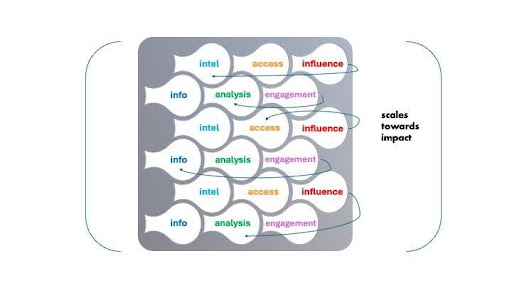
Arguably, these activities could fit into six different levels, and also on a scale from relatively simple towards the more difficult. The sequence looks like this:
- Information gathering: the daily task of filtering information across an issue, be it facts, figures, people, data, political positions or policies.
- Intelligence: information that is one level up, not easily available, requiring more specific insider knowledge and connections to obtain.
- Analysis: defining the meaning and implications of the information, research and intelligence gathered and how they affect the strategic interests of the issues or organisation.
These three are more related to incoming information, harvesting ideas, understanding the policy environment and political context, and then combining with the issue focus and putting that all into digestible, policy-ready form. The next three elements have more external or outgoing implications.
- Access: the actual level and depth of connection with policymakers and the institutions they work in.
- Engagement: how that access is used over time, planned and set out in a sustained effort towards specific policy goals, with policy material and including through communications.
- Influence: the level of relevance, salience and change accrued through this access and engagement.
None of these 6 activity levels should be done in isolation to each other. This is where overlapping fish scales and the comparable weight of activities come in.
Information informs and is informed by intelligence; intelligence informs and is informed by analysis; these three then inform and are informed by the access; in turn, the access informs and is informed by the different levels of engagement; and all of these inform and are informed by the level of influence. Voila: overlapping fish scales that work together, allow forward momentum and ensure impact.
This picture works if all elements carry the same weight, and of course, they do not. The measure of how much time and resources are spent on each level of activities – the activity weighting – depends on how the organisation has strategised, planned and budgeted. Again, this also needs a clear-sighted reflection on what type of advocacy profile an organisation has and what goes into its particular style or tactical approach.
To further illustrate the differences in activities in practice, a concern was raised with me recently by a long-time collaborator on EU advocacy: ‘the expertise has thinned, advocacy is increasingly performative’.
In this scenario, the advocates being referred to are perhaps over-egging one form of their engagement and under-resourcing their intelligence and analysis. In most situations, EU policymakers are generally not looking for simplistic emotive messaging; they are looking for thoughtful policy solutions. However, if your NGO’s issues have been scooped up into an Omnibus deregulatory bonfire, and/or the policymaker has no relevance to policy outcome (thereby reducing meaningful access), by all means, now is the time for outside-track emotiveness.
The opposite can also be true. An organisation (often a think tank, or research centre linked to a university) has the best research and analysis but is less able to translate these into Overton-window friendly policy prescriptions or deliver those messages to the most appropriate policymaker – perhaps because of a lack of inside intelligence, combined with limited focus on engagement – then a deeper dive into message construct and delivery would be useful.
The weight given to each level of activities also depends on the available resources for the organisation as a whole. Advocacy is expensive. Advocates need expertise and experience. They survive on their acumen and nous. They work in policy capitals or near centres or institutions of power, which also tend to be high-cost-of-living locations. As organisations feel the financial pressures of reduced funding and a narrative of NGO scepticism, they have to operate in survival mode; advocacy teams are often the first to be cut back.
As scarcity increases, the weight and distribution of activities then becomes incredibly important. Advocacy that was once all done in-house is being reconsidered in several ways. Three options I have seen are to outsource, upsource, or AI source, all used in combination and to varying degrees.
Out-sourcing the advocacy. This requires someone to outsource to. Often this comes in the collective activities and support from NGO coalitions or secretariats. This works to a certain point if that secretariat or partner NGOs aren’t also in survival mode, or compelled to self-sensor due to funding delays or restrictive funding guidelines for NGO advocacy. There are also various entities that could be classified as progressive public affairs agencies or advocate collectives. They are all useful for targeted and time-limited campaigns. But, with a caveat that over time, outsourced advocacy will diminish the legitimacy credentials of the outsourcing organisation.
Up-sourcing is the trend of placing more advocacy further up the food chain, often by necessity as staff numbers shrink. Executive Directors/CEOs take on more advocacy, while they also try to fill funding gaps, deal with a more hostile political environment, reduce team size, and deal with the associated internal stress.
Executive Directors may be the chief advocate in their organisation, but they would usually have a team taking care of all the activities that ensure the depth and quality of their representative work. There are excellent resources for NGO leadership support, including Nick Grono’s ‘How to Lead Nonprofits’, but there is rarely a conversation about what it means when all the advocacy is landed on the shoulders of the ED.
Then there’s AI-sourcing: using AI tools to do some of the heavy lifting of information and intelligence gathering. There are certainly efficiency gains to be had. A strategy can be drafted with a handful of prompts. The maze of institutions and personalities can be deciphered in a fraction of the time. There are good organisations helping NGOs skill up on their AI, but real human intelligence and analysis are still essential. AI only helps compile. It is not an advocacy panacea.
The primary advocacy resources are time and people, and those people need to act within a timeframe that is set by official channels and processes. Each of the ‘re-sourcings’ above might deal with a time or a people issue in the short-term, but as solutions, they may inadvertently accentuate scarcity in the mid- to long-term. The risk is that the quality of the advocacy will drop, access will become restricted, ED’s and other staff burn out, and influence fades. In turn, that will lead to more perfunctory official engagement, and at least in the EU context, empty promises to respect participatory democracy.
What can be done?
For NGOs: First, understand how each advocacy team spreads across the activity scales. How are tasks divided, and what weight is given to each activity. Are the gaps intentional or by default? Do the combined set of activities lead to productive engagement? How do they combine with your advocacy profile and the changing nature of public policy process?
Second, understand where your people are best allocated within the activity scale – rather than adjusting the activity scale to the people. Seek transition support from experts, such as Civic Strength Partners. Compensate for necessary cuts by limited re-sourcing, or rationalising, and explain to funders what the implications of advocacy cuts will mean for advocacy activities, profile and strategy success. If rationalising includes combining advocacy and communications teams – an NGO version of policy comms as explained by the Centre for Future Generations’ Rowan Emslie – then do a health check with those who have tried to take that leap already.
Third, consider how to ensure that influence is maintained by a careful readjustment of focus of these activities and ensure that a narrative of adjustment and needs are clearly communicated to boards and funders (with minimal jargon and maximum use of practical examples).
For Funders: First, ensure that your grantmakers – especially those funding advocacy organisations or campaigns – are supported by colleagues with advocacy and policy experience (or bring their own experience). Operational/core grantmaking is an intricate skill, but beyond the regulatory differences, there are different conversations, tactics and timelines when advocacy and influence are involved. Funders that use the same paradigm for each of these funding channels risk losing the nuances of policy change.
Second, ask the difficult questions about advocacy activities under pressure. Ensure that this set of conversations is placed within a context of support and partnership, rather than a quantitative and/or punitive assessment. Many advocates have been put in the position of over-claiming their role on the activity scale – more access, better engagement, exaggerated influence – because they are forced into an artificial quantitative defence of their role. A respectful dialogue that focuses on qualitative implications, careful adjustments and strategic shifts is much more appropriate than inciting performative show ponies.
Third, look at how you can support the existing advocacy set-up and the survival shifts that are necessary. Is there an advocacy ecosystem that can substitute or bolster the stresses faced by individual organisations? Can you help the out-sourced entities (coalitions and secretariats especially) through additional capacity? When advocacy is being up-sourced to directors, do they have the skills and time to take on that extra load? Are they at risk of burnout? As a philanthropy, can you engage your own policy staff to provide more strategic advocacy support to sectors under intense pressure? Ask how teams engage with AI tools and the extent to which they assist, or become a substitute for real, in-person policy engagement. Funders might not be able to save cash-strapped NGOs, but they can help them evolve through and beyond survival mode – while maintaining their voice and credibility for advocacy.
These three approaches to advocacy scale are aimed at improving clarity ahead of difficult organisational and strategic decisions. When advocacy activities are assessed and understood through their place on a progressing scale, through the weight and focus on each of those elements, and how they overlap and support each other within an advocacy team, the result is more holistic clarity on what advocacy actually entails.
Back to the perennial advocacy question. Ambiguity about the actual causal impact of advocacy activities, or different definitions and dialects of advocacy tactics, should not be an excuse for vagueness around the practical activities of advocacy. How it is done is counter-intuitively easier to explain than what it is. Activities should be honestly and openly assessed, understood and scaled according to resources, challenges and goals.
There’s also a future dividend to these scarcity-induced learnings and adjustments: when conditions are right to scale up again, NGOs and funders will know exactly where to look.
Written by Neil Campbell